

12 Things to Do in Badrinath Beyond Darshan: Places to Visit In and Around Town
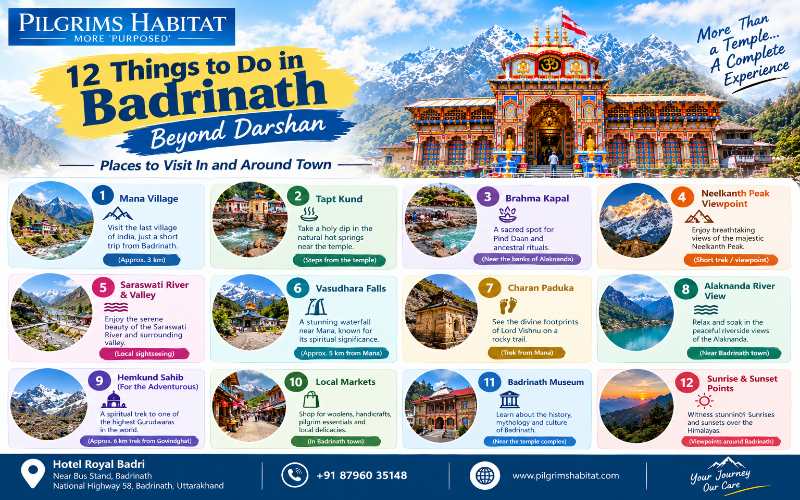
Most pilgrims come to Badrinath for one darshan and leave the next morning. That’s a shame. Within 10 km of the temple you’ll find a natural hot spring, the river confluence where the Saraswati meets the Alaknanda, a stone bridge from the Mahabharata, caves linked to Ved Vyasa, a 122-metre waterfall, and some of the best Himalayan views anywhere. Give Badrinath two nights and you’ll see most of them without rushing.
Here’s the list, with distance, time needed and who each one suits.
Things to do in Badrinath at a glance

# | Place or activity | Distance from temple | Time needed | Effort |
|---|---|---|---|---|
1 | Tapt Kund and Narad Kund | Below the temple | 30 to 45 min | Easy |
2 | Brahma Kapal | Beside the temple, on the river | 30 min to 2 hours (with rituals) | Easy |
3 | Badrinath temple aarti | At the temple | 1 hour | Easy |
4 | Badrinath market | Temple lane and bazaar | 30 to 60 min | Easy |
5 | Sheshnetra | About 1.5 km | 1 hour | Easy |
6 | Charan Paduka | About 3 km uphill | 3 to 4 hours round trip | Moderate |
7 | Mata Murti temple | About 3 km | 1 to 1.5 hours | Easy (by road) |
8 | Mana village | About 3 to 4 km | Half day | Easy to moderate |
9 | Bhim Pul and Saraswati river | At Mana | Included in Mana visit | Easy |
10 | Vyas Gufa and Ganesh Gufa | At Mana | Included in Mana visit | Easy (some steps) |
11 | Neelkanth peak sunrise | From town viewpoints | 30 to 60 min | Easy |
12 | Vasudhara Falls | About 6 km beyond Mana | 4 to 5 hours return | Moderate to hard |
Bonus within 25 km: Yogdhyan Badri at Pandukeshwar and Govindghat, the trailhead for Hemkund Sahib and the Valley of Flowers.
1. Bathe at Tapt Kund (and see Narad Kund)

Tapt Kund is a natural hot spring just below the temple, at a steady temperature of around 55°C. It sits a few steps from the freezing Alaknanda. Pilgrims traditionally bathe here before darshan, and on a cold October morning, it’s the most welcome thing in Badrinath.
Next to it is Narad Kund, a recess in the river where, by tradition, Adi Shankaracharya recovered the idol of Badrinarayan before re-enshrining it. Our Tapt Kund and Brahma Kapal walk explains the order most pilgrims follow.
2. Perform pind daan at Brahma Kapal

Brahma Kapal is a flat rock platform on the Alaknanda bank, just beside the temple. Hindus believe that offering pind daan (rites for ancestors) here holds special significance. Rituals with a local pandit take anywhere from 30 minutes to over two hours. Read our guide to pind daan at Brahma Kapal before you go.
3. Attend the morning or evening aarti

The temple aarti is the heart of a Badrinath visit. Mornings start very early with the abhishek. Evenings end with the shayan aarti, when the Geet Govind is sung and the deity is put to rest for the night. Arrive at least 30 to 45 minutes early in peak season. For the full background on the deity and temple, see our Badrinath temple facts.
4. Walk the Badrinath market

The lane leading to the temple and the main bazaar sell prasad, rudraksha and tulsi malas, shawls, woollens and small brass idols. It’s the place to pick up gifts for family back home. Prices are higher than in the plains, so bargain politely for woollens.
5. Visit Sheshnetra

About 1.5 km from the temple, Sheshnetra is a small shrine named after Sheshnag, the serpent on which Vishnu rests. A boulder here is said to carry the impression of Sheshnag’s eye. It’s an easy walk and a quiet contrast to the busy temple area.
6. Hike to Charan Paduka

Charan Paduka is a rock believed to bear the footprints of Lord Vishnu, about 3 km uphill on the Narayan Parbat side of town. The path starts near the temple, climbs steadily past boulders and small caves, and takes most people about 1.5 hours up. On a clear day you’ll get views of Neelkanth and Nar Parbat that you won’t see from the town.
Who it suits: Reasonably fit adults. It’s steep for seniors at this altitude, so go slowly and carry water.
7. Visit Mata Murti temple

About 3 km from Badrinath on the Mana side of the Alaknanda, Mata Murti temple is dedicated to the mother of Nar and Narayan. It’s a small, peaceful temple on the riverbank. A fair (mela) is held here each year in the Bhadrapad month, usually in September, when the Badrinath deity is ceremonially brought to visit.
You can combine it with Mana in a single half-day outing.
8. Spend half a day in Mana village

Mana sits about 3 to 4 km from Badrinath, close to the India-Tibet border. It’s famous as one of India’s last villages before the border, though what makes it worth the trip is the stone houses, the Bhotia culture, the woollen shawls woven at home, and the tea stalls with “India’s last tea shop” signs.
Shared taxis run from Badrinath for around ₹100 to ₹200 per person, and a private cab is about ₹700 to ₹1,200 return with waiting. Our complete Mana village day trip guide has the timings and costs.
9. Stand on Bhim Pul above the Saraswati

At Mana, the Saraswati river crashes through a narrow gorge under a huge natural rock slab. Legend says Bhim, the strongest of the Pandavas, placed it there so Draupadi could cross. Just downstream, the Saraswati joins the Alaknanda at Keshav Prayag. The sound alone is worth the walk.
10. Visit Vyas Gufa and Ganesh Gufa

Also in Mana, Vyas Gufa is the cave where Ved Vyasa is believed to have composed the Mahabharata, with Ganesh Gufa, where Ganesha is said to have written it down, a short walk away. Both are small, with a few steps to climb, and they’re usually busy in the late morning. Go early.
11. Watch sunrise on Neelkanth peak

Neelkanth peak (6,596 m) rises behind Badrinath temple. On clear mornings, its summit turns pink and gold before the valley gets any sunlight. You can watch from the temple area, the bridge, the riverbank or a hotel rooftop facing south-west. October gives the clearest skies.
Our guides to Neelkanth sunrise viewpoints and sunrise and sunset spots list the best places.
12. Trek to Vasudhara Falls

Vasudhara Falls drops about 122 metres (around 400 ft) from a cliff about 6 km beyond Mana. The trail starts at Mana village and climbs steadily along the Alaknanda valley at over 3,000 metres. Allow 4 to 5 hours for the round trip from Mana, more if you stop often. It’s the gateway to the longer Satopanth Tal trek.
Who it suits: Fit walkers with good shoes. It’s not suitable for small children or anyone with breathing problems at altitude. Start by 8 am and turn back if the weather closes in.
Bonus: day trips within 25 km
- Yogdhyan Badri, Pandukeshwar (about 20 km downhill): one of the Panch Badri shrines, worth a stop on your way in or out.
- Govindghat (about 25 km): the trailhead for Hemkund Sahib and the Valley of Flowers. If your trip includes the trek, read our Govindghat guide.
How to fit it all in: a two-night plan

Day 1 (arrival afternoon): Check in and rest. Walk to Tapt Kund and Brahma Kapal at around 4 pm, then attend the evening aarti and browse the market.
Day 2: Watch the sunrise on Neelkanth. Bathe at Tapt Kund and take early darshan. After breakfast, take a taxi to Mana for Bhim Pul, Vyas Gufa and Ganesh Gufa, stopping at Mata Murti on the way back. Rest in the afternoon. Optional evening darshan.
Day 3 (if staying a third night): Charan Paduka in the morning, or the Vasudhara Falls trek for the fit, or Sheshnetra for a gentle walk.
For a feel of how Badrinath changes through the day, read Badrinath by the hour.
Badrinath mein ghumne ki jagah

Badrinath mein darshan ke alawa Tapt Kund, Brahma Kapal, Narad Kund, Sheshnetra, Charan Paduka aur Mata Murti mandir dekhiye. Lagbhag 3 se 4 km door Mana gaon mein Bhim Pul, Vyas Gufa aur Ganesh Gufa hain. Fit log Mana se Vasudhara Falls ka trek kar sakte hain. Sab kuch aaraam se dekhne ke liye Badrinath mein do raat rukiye.
Frequently Asked Questions
The top places are Badrinath temple, Tapt Kund, Brahma Kapal, Narad Kund, Charan Paduka, Sheshnetra and Mata Murti temple in town, plus Mana village with Bhim Pul, Vyas Gufa and Ganesh Gufa about 3 to 4 km away. Fit visitors can trek to Vasudhara Falls.
Two nights are enough for most pilgrims to cover darshan, Tapt Kund, Mana village and a sunrise view of Neelkanth without rushing. Add a third night for Charan Paduka or the Vasudhara Falls trek, or to rest before the long drive back to Haridwar.
Mana village is about 3 to 4 km from Badrinath temple. Shared taxis cost around ₹100 to ₹200 per person, and a private cab with waiting costs about ₹700 to ₹1,200 return. Some people walk, but at this altitude most prefer a vehicle.
Charan Paduka is about 3 km uphill from Badrinath temple. The trail starts near the temple and takes about 1.5 hours to climb, so allow 3 to 4 hours for the round trip. It’s a moderate walk, best done in the morning with water and warm layers.
Vasudhara Falls is about 9 km from Badrinath: roughly 3 km to Mana by road and then about 6 km on foot. The walk from Mana takes 4 to 5 hours return. The waterfall drops about 122 metres from a high cliff.
Tapt Kund is a natural hot spring just below Badrinath temple, with water at around 55°C. Pilgrims traditionally bathe here before darshan. It sits beside the icy Alaknanda river, and there are separate bathing areas for men and women.
Yes, especially if you’re going to Mana. Mata Murti temple is about 3 km from Badrinath on the Alaknanda bank and is dedicated to the mother of Nar and Narayan. It’s quiet and rarely crowded, and an annual fair is held here, usually in September.
Badrinath market sells prasad, tulsi and rudraksha malas, small brass idols, woollen shawls, caps and socks, and local herbs. Mana village is known for hand-woven woollens. Prices are higher than in the plains, so compare a few shops before buying.
Yes. Tapt Kund, the temple, Brahma Kapal, the market, Mata Murti temple and Mana village (by taxi) are all manageable for most seniors. Charan Paduka and Vasudhara Falls involve steep walking at altitude and are better skipped unless the person is fit and acclimatised.
Yes. The evening aarti at Badrinath temple is the highlight, with the shayan aarti closing the day. You can also walk along the riverbank, browse the market, or watch the last light on Neelkanth and Nar Parbat from a hotel rooftop.
All Categories
Recent Post
-
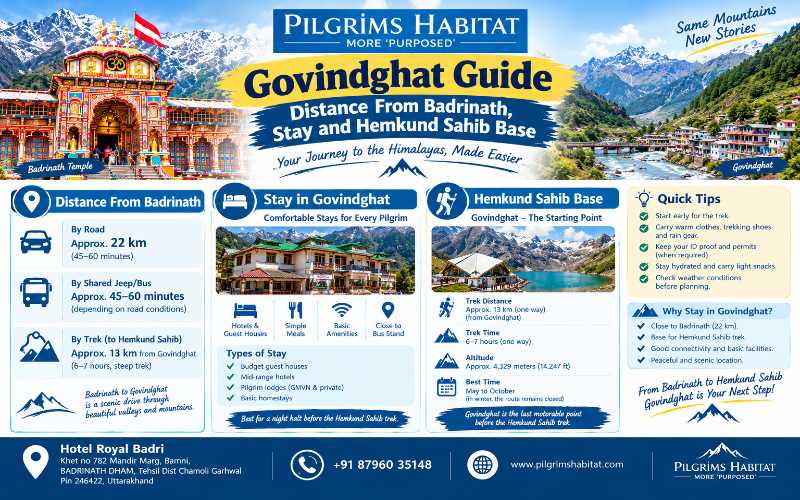 26 Oct 2026 UncategorizedGovindghat Guide: Distance From Badrinath, Stay and Hemkund Sahib Base
-
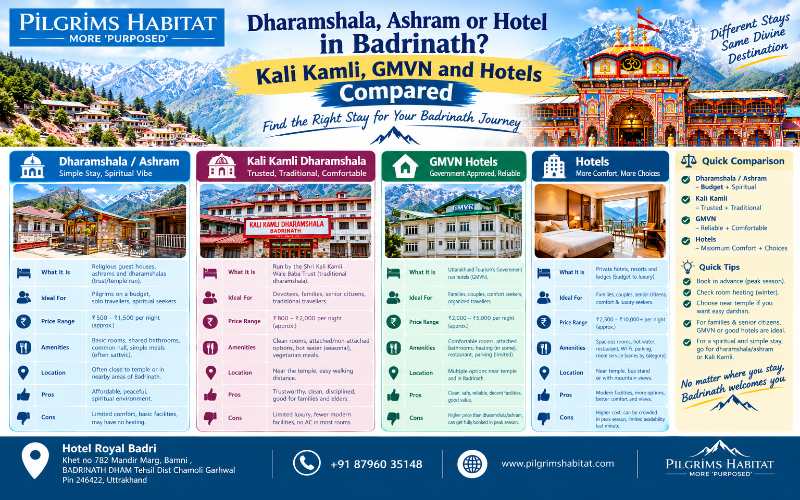 23 Oct 2026 UncategorizedDharamshala, Ashram or Hotel in Badrinath? Kali Kamli, GMVN and Hotels Compared
-
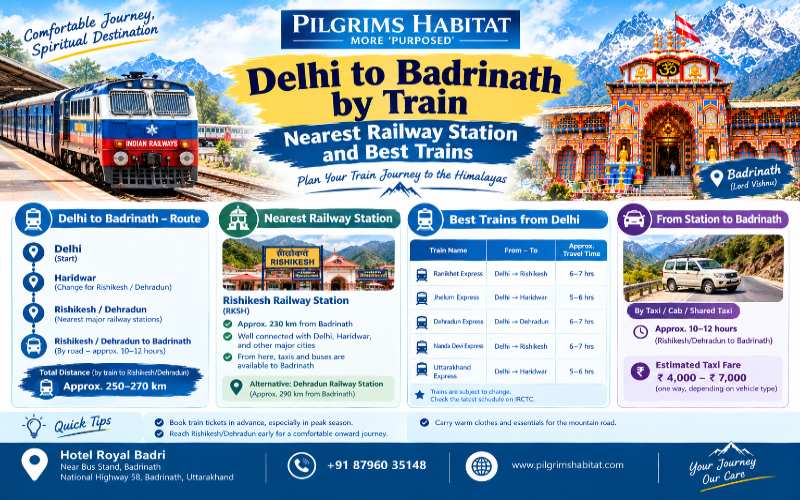 22 Oct 2026 UncategorizedDelhi to Badrinath by Train: Nearest Railway Station and Best Trains
-
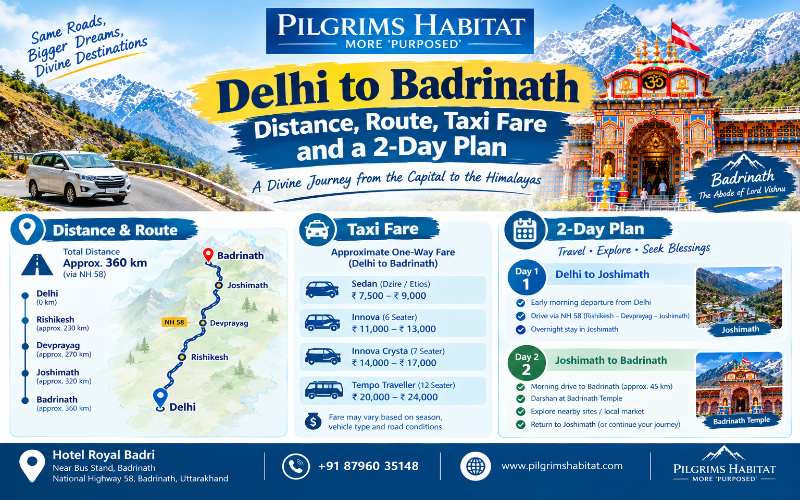 21 Oct 2026 UncategorizedDelhi to Badrinath: Distance, Route, Taxi Fare and a 2-Day Plan
-
19 Oct 2026 Uncategorized12 Things to Do in Badrinath Beyond Darshan: Places to Visit In and Around Town
Stay two nights and see it all
Hotel Royal Badri is on the main road near the Badrinath bus stand, about 900 m from the temple. We can help you arrange taxis to Mana and Govindghat, pack breakfast for early starts, and tell you which mornings look clear for Neelkanth. See Hotel Royal Badri or WhatsApp +91 87960 35148.

2 Responses