

Badrinath in Winter 2026-27: What Happens After Kapat Closing?
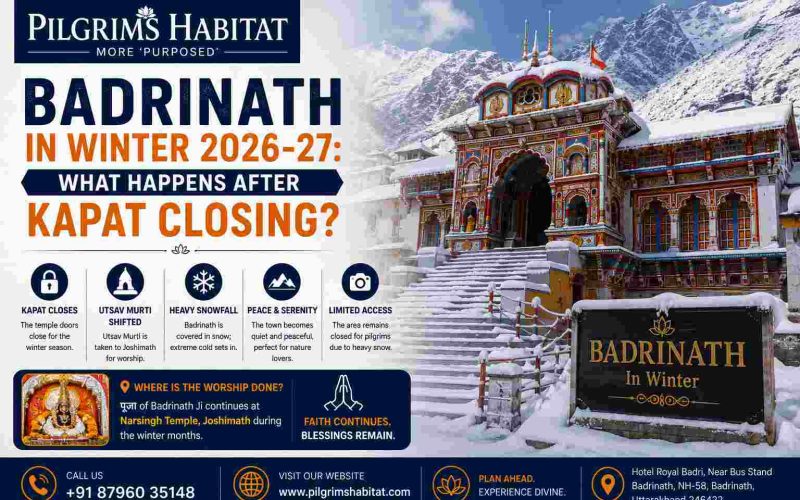
After the Badrinath in Winter 2026-27 kapat closes in November 2026, the town becomes largely inaccessible due to heavy snowfall, and the deity’s ceremonial seat moves to the Narsimha Temple in Joshimath for winter worship. Badrinath town itself shuts down — hotels, restaurants, and nearly all services close for the season. The region does not reopen for pilgrimage until late April 2027, around Akshaya Tritiya. This guide tells you exactly what happens to Badrinath after closing, what Joshimath offers as a winter pilgrimage alternative, what the region looks like in December, and how to start planning your 2027 yatra right now.
Badrinath Winter 2026-27: Quick Reference Answers
Question | Direct Answer |
Is Badrinath accessible in winter 2026? | No — the town is inaccessible from November 2026 to late April 2027 due to heavy snowfall blocking all roads. |
Is the Badrinath Temple open in winter? | No — the kapat closes around Bhai Dooj (~11–13 Nov 2026) and does not reopen until Akshaya Tritiya in late April 2027. |
Where does the deity go after closing? | The ceremonial seat of Lord Badrinarayan moves to the Narsimha Temple in Joshimath, where daily worship continues through winter. |
Can I do a winter trek to Badrinath? | Technically possible with specialist high-altitude equipment and permits — but not viable or advisable for general pilgrims. Joshimath is the appropriate winter alternative. |
When does Badrinath reopen? | Late April 2027, around Akshaya Tritiya. The exact date is announced on Basant Panchami (Jan/Feb 2027). |
What should I do if I missed the 2026 season? | Visit the Narsimha Temple at Joshimath through winter, then book Hotel Royal Badri for early May 2027 to catch the opening darshan. |
Is Badrinath Accessible During Winter 2026?
Badrinath is not accessible to general visitors during winter 2026-27. The town sits at 3,133 metres in the Garhwal Himalayas, and heavy snowfall — typically beginning in late November — blocks all road access completely. The Rishikesh–Joshimath–Badrinath highway shuts down for the winter season after the kapat closing, and both the BKTC and Uttarakhand state authorities formally close the route to civilian traffic.
The practical reality: Badrinath town empties out within days of the kapat closing. Hotels, dhabas, shops, and all services close. The handful of locals who remain in Joshimath (46 km lower) do not typically travel the final mountain stretch to Badrinath during the peak winter months. Even with private vehicles and specialist equipment, the road is not consistently passable from December through March.
If you are planning your trip and want to understand the closing date specifically, our Badrinath kapat closing 2026 guide covers the Bhai Dooj ceremony, the ritual sequence, and the exact 2026 closing date.
What Happens to Badrinath After the Kapat Closes in 2026?
Three things happen simultaneously when the Badrinath kapat closes:
- The deity’s ceremonial seat moves. The priests perform the final closing rituals — Mahabhishek and the lighting of an eternal jyoti lamp inside the sanctum — and the temple doors are sealed. Lord Badrinarayan’s symbolic presence then transfers to the Narsimha Temple in Joshimath, where daily puja and aarti continue uninterrupted through the entire winter.
- The town shuts down. Within days, hotels and restaurants close, permanent residents depart, and the roads into Badrinath are vacated. Snow accumulates rapidly at this elevation, and the town transitions into a state of complete winter silence that many devotees describe as awe-inspiring in its own right.
- The pilgrimage community shifts to Joshimath. Devotees who want to maintain their winter worship practice visit the Narsimha Temple at Joshimath — the traditional winter seat of B
Where Does Worship Continue During Badrinath's Winter Closure?
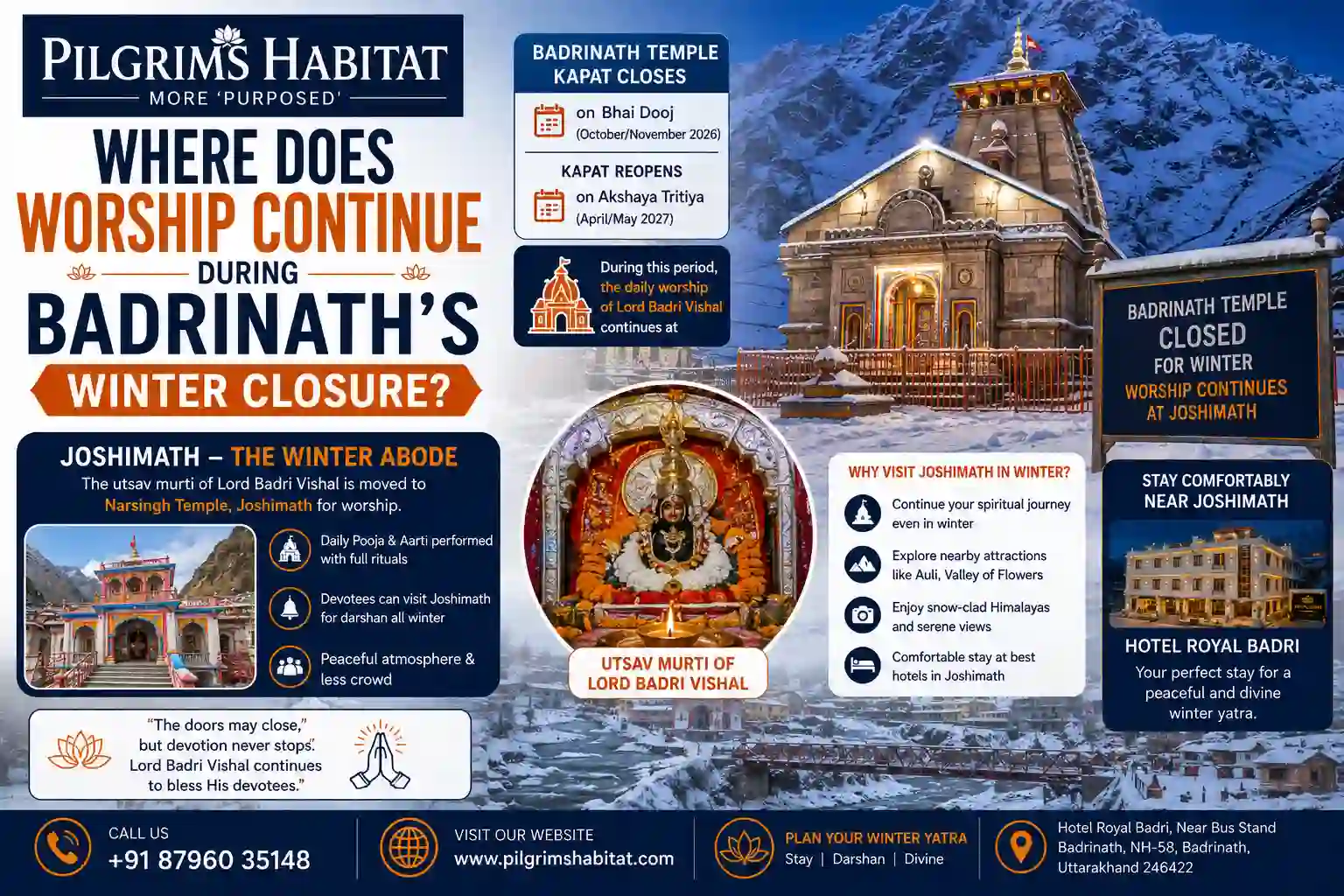
The Narsimha Temple in Joshimath is where worship continues throughout Badrinath’s winter closure. Located approximately 45 kilometres from Badrinath at a lower, more accessible elevation, Joshimath (also called Jyotirmath) is one of the four peeths established by Adi Shankaracharya. Badrinath’s winter deity is formally installed here each November and remains until the spring reopening.
Joshimath in winter offers: daily puja and aarti at the Narsimha Temple, the Shankaracharya Math (monastery), and the ancient mulberry tree associated with the Katyuri dynasty. The town is accessible by road in winter — unlike Badrinath — and local accommodation remains available for pilgrims who visit specifically for the winter darshan.
Joshimath is also the gateway for several winter adventure activities in the surrounding area — see the winter adventure section below.
What Are Typical Winter Weather Conditions in Badrinath in 2026?
Badrinath in winter (November–April) experiences extreme cold with heavy snowfall that makes the town completely uninhabitable without specialist equipment.
Month | Estimated Temperature | Snowfall | Road Access | Habitation |
November (post-closing) | -5°C to -15°C | Heavy snowfall begins | Closed to civilian traffic | Town empty |
December 2026 | -10°C to -25°C | 1–3 metres accumulation | No road access | Completely uninhabited |
January 2027 | -15°C to -30°C | Peak snowfall; 3–5+ metres | No road access | Completely uninhabited |
February 2027 | -12°C to -25°C | Continued heavy snowfall | No road access | Completely uninhabited |
March 2027 | -8°C to -20°C | Gradual taper | Starts clearing late March | BRO begins clearance |
April 2027 | -2°C to +8°C | Snow retreats from road | Road clearing in progress | Pre-opening preparations |
Winter weather forecast note: specific temperature and snowfall forecasts for December 2026 – April 2027 will be available closer to those dates from the India Meteorological Department (IMD). The figures above represent historical averages. Check IMD (mausam.imd.gov.in) for current-season forecasts when planning.
What Permits Are Required for Visiting Badrinath During Winter 2026?
No standard permit system enables general civilian access to Badrinath town during winter. The BKTC and Uttarakhand state formally close the route after kapat closing, and there is no permit that overrides this for tourist or pilgrim access. The road itself is physically impassable for most of the winter due to snowfall.
The exception — specialist research or administrative access: certain government-approved expeditions, BKTC maintenance teams, and ITBP (Indo-Tibetan Border Police) personnel operate in the region through winter with specialist vehicles and permits. This is not a pathway for pilgrims.
For Joshimath access: no permit is required to visit Joshimath during winter. The town remains accessible by road and open to all visitors. The mandatory Char Dham Yatra registration applies only during the official pilgrimage season (April–November). For more on registration requirements, see our Char Dham Yatra registration 2026 guide — this applies to the 2027 opening season, not the current winter closure.
Recommended Travel Routes to Badrinath Region for December 2026
Do not attempt to reach Badrinath town in December 2026 — the road is closed and the town is uninhabited. For winter devotional travel to the Badrinath region, the accessible route goes to Joshimath:
Starting Point | Route to Joshimath | Distance | Drive Time | Status in December |
Delhi | NH58 / NH7 via Haridwar, Rishikesh, Devprayag, Rudraprayag, Chamoli, Joshimath | ~500 km | 14–16 hours (2-day journey recommended) | Open — but check conditions before the Chamoli stretch |
Haridwar | Via Rishikesh, Devprayag, Rudraprayag, Chamoli, Joshimath | ~270 km | 9–11 hours | Generally open; conditions vary near Chamoli in heavy snow |
Dehradun | Via Rishikesh then as above | ~310 km | 10–12 hours | Open |
Rishikesh | Via Devprayag, Rudraprayag, Chamoli, Joshimath | ~255 km | 9–10 hours | Open; check BRO updates for Chamoli section |
Badrinath town (46 km beyond Joshimath): road closed from approximately November to late March. Do not attempt this stretch without verified official reopening confirmation.
Top-Rated Guided Winter Treks Near Badrinath in 2026
Badrinath town is not accessible for trekking in winter 2026. However, the wider Joshimath area offers legitimate winter adventure activities for those seeking high-altitude experiences in the region.
Activity | Base | Difficulty | Best Months | Notes |
Auli Ski Resort | Auli (via Joshimath, 16 km by ropeway or road) | Beginner to Intermediate | Jan–Feb 2027 | Government-operated ski resort; skiing lessons, equipment rental available |
Auli–Gorson Bugyal Trek | Auli | Easy–Moderate | Dec–Feb | Snow-covered meadow trek with Himalayan peak views; guided tours available |
Kuari Pass Winter Trek | Joshimath | Moderate–Hard | Dec–Mar | Classic Himalayan winter trek; specialist tour operators required |
Pangarchulla Peak | Joshimath | Hard | Feb–Mar | Technical winter mountaineering; for experienced alpinists only |
Valley of Flowers (winter hike) | Joshimath area | Hard | Not recommended — deep snow | Wait for June–September season; winter access is not viable |
Are There Local Guides Available in Badrinath for Winter Treks in 2026?
No guides operate in Badrinath town during winter — the town is uninhabited. Joshimath is where registered winter guides operate for the Auli ski area, Gorson Bugyal, Kuari Pass, and other accessible winter routes. The Joshimath tourism office and registered local guide associations maintain active rosters during the ski and trekking season. For any winter adventure booking in the Joshimath area, ask Hotel Royal Badri’s Anugraha Concierge team for referrals to verified operators we work with during the off-season — our team stays connected to the local Joshimath network through winter.
What Affordable Winter Accommodation Options Exist Near Badrinath?
Location | Distance from Badrinath | Winter Status | Accommodation Type |
Joshimath | ~46 km (road closed beyond) | ✅ Open year-round | Multiple hotels and guesthouses; Auli season brings good availability |
Auli | ~16 km from Joshimath by ropeway | ✅ Open in ski season (Dec–Feb) | Ski resort hotels and GMVN tourist bungalow |
Chamoli | ~90 km from Badrinath | ✅ Open year-round | Basic town accommodation |
Gopeshwar | ~95 km from Badrinath | ✅ Open year-round | District headquarters; better facilities than Chamoli |
Badrinath Town | 0 km | ❌ Completely closed November–April | No accommodation available |
Online Platforms to Book Badrinath Region Winter Hotel Stays 2026
For Joshimath winter accommodation, book through MakeMyTrip, Booking.com, or GMVN (Garhwal Mandal Vikas Nigam) at gmvnl.com — GMVN operates tourist bungalows across Uttarakhand including at Joshimath and Auli. Booking.com and MakeMyTrip carry private hotel inventory in Joshimath. Auli ski resort accommodation should be booked through GMVN or through specialist ski tour operators well in advance of the January–February peak ski window.
What Specialised Clothing and Gear Do You Need for Badrinath Region in Winter?
Winter in the Badrinath region — including Joshimath and Auli — requires proper cold-weather gear. Temperatures regularly drop to -15°C to -25°C at higher elevations, with windchill making it feel significantly colder. This is not manageable with standard mountain clothing; genuine winter insulation is required.
Item | Specification Needed | Recommended Brands |
Down jacket / puffer (outer) | 700+ fill power; rated to -20°C or below | Decathlon Forclaz, The North Face, Arc’teryx, Marmot |
Thermal base layer | Merino wool or heavyweight synthetic; not cotton | Icebreaker (merino), Decathlon Forclaz, Smartwool |
Fleece mid-layer | Heavyweight fleece (300g+) | Decathlon Forclaz 900, Patagonia R2 |
Waterproof shell jacket + trousers | Goretex or equivalent membrane | The North Face, Columbia, Wildcraft Pro |
Insulated waterproof boots | Rated to -30°C or below; ankle-height minimum | Sorel, Baffin, Columbia Bugaboot |
Wool socks (heavyweight) | Merino wool; 3–4 pairs minimum | Icebreaker, Darn Tough, Decathlon wool socks |
Balaclava | Full face coverage for outdoor exposure | Decathlon, Buff, Mountain Equipment |
Insulated gloves (outer) + liner gloves | Waterproof outer; wool or fleece liner | The North Face, Black Diamond, Decathlon |
Snow gaiters | Prevents snow entering boots during treks | Outdoor Research, Decathlon |
Glacier sunglasses / ski goggles | UV400; high-altitude snow reflection is intense | Julbo, Oakley, Decathlon |
What Health Precautions Are Advised for High-Altitude Travel to Badrinath Region in Cold Weather?
Winter travel to Joshimath (at ~1,890 metres) carries far lower altitude risk than Badrinath (3,133 metres), but cold-weather health precautions still apply:
- Hypothermia awareness — know the signs (shivering stops, confusion, slurred speech) and carry emergency thermal blankets
- Frostbite prevention — keep extremities covered at all times in sub-zero conditions; wool base layer gloves under waterproof outer gloves
- Carry a pulse oximeter — even at Joshimath’s lower altitude, monitor SpO2 if you feel unusually breathless
- Stay hydrated — cold suppresses thirst instinct; dehydration at altitude worsens all other conditions
- Cardiovascular preparation — consult your doctor before any winter high-altitude travel if you have heart or blood pressure conditions
- Acclimatise in Rishikesh or Haridwar for a day before proceeding to Joshimath in winter
Popular Winter Adventure Activities Near Badrinath 2026
The Badrinath region transforms into a winter adventure zone centred on Joshimath and Auli from December 2026 through February 2027.
Skiing at Auli
Auli is the most developed ski resort in India, located 16 kilometres from Joshimath by ropeway or road. The Auli ski slopes run from approximately 2,519 metres to 3,049 metres, with ski runs of up to 3 km. The Gondola (ropeway) connects Joshimath to Auli and operates in the ski season. GMVN operates the resort and offers ski rental equipment and lessons. The Auli ski season typically runs January to March, with peak snow from January 15 to February 28.
Gorson Bugyal Snow Trek
Gorson Bugyal is a high-altitude meadow (~3,056 metres) accessible from Auli via a 3–4 km trek through oak forests. In winter, the meadow fills with snow and offers one of the most accessible and visually dramatic snow-landscape experiences in the Garhwal Himalayas without requiring technical mountaineering skills.
Kuari Pass Winter Trek
Kuari Pass (~3,640 metres) sits above Joshimath and offers views of Nanda Devi, Kamet, Dunagiri, and the entire Garhwal peak chain. The winter version of this trek requires specialist equipment and an experienced guide — but it is one of the most spectacular Himalayan winter treks accessible from the Badrinath region.
How Do You Book Bus or Taxi Services to the Badrinath Region in Winter 2026?
To reach Joshimath in winter, use private cabs or Uttarakhand Roadways buses from Haridwar or Rishikesh. The state bus service runs year-round to Joshimath, though frequency drops in the deep winter months. Private cabs from Haridwar or Rishikesh remain available and are the most reliable option for flexibility in winter road conditions.
Rental Vehicle Services for Travel to the Badrinath Region in Winter 2026
Rent a high-ground-clearance vehicle — not a sedan — for winter travel in the Garhwal Himalayas. Innova Crysta, Scorpio, and Bolero 4WD are the most appropriate vehicles for Chamoli-district winter roads. GMOU-regulated taxi operators in Haridwar and Rishikesh maintain winter vehicle availability. Confirm the vehicle has snow chains available and the driver has winter mountain driving experience before booking.
Local Transport Services Around Badrinath Region in Winter 2026
Within Joshimath and the Auli area, shared taxis and the GMVN-operated Gondola ropeway connect the town to Auli. Local shared taxis run between Joshimath and Chamoli. No public transport connects Joshimath to Badrinath town during winter — the road beyond Joshimath closes seasonally.
Are There Organised Tours to Badrinath Available for Winter 2026?
No legitimate tour operator runs pilgrimage tours to Badrinath town during winter 2026 — the town is inaccessible and uninhabited. Tour operators that claim ‘winter Badrinath yatra packages’ are either misrepresenting the destination or offering Joshimath-based itineraries under the Badrinath name. Clarify with any operator exactly where the tour reaches and stays before booking.
Legitimate winter packages in the Badrinath region include: Auli ski packages (GMVN-operated or through private ski tour operators), Kuari Pass winter trek packages, and Joshimath-based Narsimha Temple pilgrimage packages for devotees who want to maintain their winter worship connection.
Best Travel Agencies for Badrinath Region Winter Tours 2026
For Auli ski packages: GMVN (gmvnl.com) is the most reliable operator; also check Thrillophilia and MakeMyTrip for private operator packages.
For Kuari Pass or winter trekking: Indiahikes, Bikat Adventures, and Trek the Himalayas are established operators with specific Kuari Pass winter programmes. Always confirm the guide’s certification and the operator’s emergency protocol before booking.
For Narsimha Temple / Joshimath pilgrimage: Haridwar-based Char Dham yatra operators maintain winter Joshimath programmes for devotees. Ask Hotel Royal Badri’s Anugraha Concierge team for operator referrals — we maintain connections with reliable Joshimath operators through the off-season.
Winter Travel Insurance Options for Badrinath Region Pilgrimages 2026
Winter travel in the Badrinath region requires more comprehensive insurance than the standard pilgrimage season because cold-weather risks and emergency response times are both more serious. Key coverage to verify for winter Joshimath or Auli travel:
- Cold-weather medical coverage — including hypothermia, frostbite, and high-altitude pulmonary or cerebral edema
- Winter sports coverage (for Auli skiing) — standard travel insurance specifically excludes ski injuries; a winter sports add-on is required
- Helicopter medical evacuation — AIIMS Rishikesh is 270 km from Joshimath; evacuation by helicopter is the only viable emergency option in serious cases
- Trip cancellation for weather or road closure — winter road closures are common; this provision is more valuable in winter than in the pilgrimage season
- Altitude coverage above 2,000 metres — some plans cap at 2,500 m; Auli and Kuari Pass exceed this
Providers to compare: HDFC ERGO Travel Secure, Bajaj Allianz Travel Insurance, Care Health Travel Plan, and Tata AIG Travel Guard. For ski-specific coverage, check whether your chosen plan includes a winter sports endorsement.
Average Budget for a 5-Day Trip to the Badrinath Region in Winter 2026
A 5-day winter trip to the Joshimath and Auli area from Delhi is significantly more affordable than a peak-season Badrinath yatra.
Item | Budget Option | Mid-Range Option | Notes |
Transport (Delhi–Joshimath–Delhi, private cab) | ₹8,000 – ₹12,000 | ₹12,000 – ₹18,000 | Train + bus to Haridwar, then cab reduces cost |
Accommodation (4 nights, Joshimath/Auli) | ₹2,500 – ₹5,000 | ₹5,000 – ₹10,000 | GMVN bungalow is good budget option; Auli ski hotels are pricier |
Meals (4 days × 3 meals) | ₹2,400 – ₹4,000 | ₹4,000 – ₹6,000 | Joshimath has good basic restaurants; Auli dining is pricier |
Ski pass + equipment rental (2 days, Auli) | ₹2,000 – ₹3,000 (skiing only) | ₹4,000 – ₹6,000 (with lessons) | For non-skiers: Gondola ride is ₹500–₹750 |
Guide (1 day snow trek) | ₹800 – ₹1,500 | ₹1,500 – ₹3,000 | Gorson Bugyal guide for snow conditions |
Travel insurance | ₹1,500 – ₹2,500 | ₹2,500 – ₹5,000 | Include winter sports endorsement if skiing |
Approximate 5-day total (per person) | ₹17,200 – ₹28,000 | ₹29,000 – ₹48,000 | Group of 2–4 reduces per-person transport cost significantly |
How to Plan Your Badrinath Yatra for the 2027 Opening Season
The smartest use of Badrinath’s winter closure is to plan your 2027 yatra right now, before the season opens and availability competes. Here is the timeline:
Date | Action |
January / February 2027 | The 2027 opening date is announced on Basant Panchami. Watch BKTC (bktc.nic.in) and Uttarakhand Tourism social media for the announcement. |
Immediately after announcement | Book Hotel Royal Badri for opening week (late April 2027). First-week rooms near the temple sell out fastest every year. |
February / March 2027 | Complete Char Dham Yatra registration at registrationandtouristcare.uk.gov.in once the 2027 portal opens. |
March / April 2027 | Book transport — GMOU cabs from Haridwar fill quickly for the opening days. Private booking from Delhi requires advance arrangement. |
Late April 2027 | Attend the kapat opening ceremony at Badrinath — one of the most spiritually charged events in the Garhwal pilgrimage calendar. |
For guidance on the opening season specifically, bookmark our best time to visit Badrinath guide and our Char Dham Yatra registration 2026 guide — both will be updated with 2027 season information as soon as the opening date is announced.
More Planning Guides From Pilgrims Habitat
Related guides for your Badrinath yatra planning: Badrinath Kapat Closing 2026 – Full Guide · Diwali & Bhai Dooj at Badrinath – Closing Ceremony · Best Time to Visit Badrinath · Off-Season Hotel Deals in Badrinath · Char Dham Yatra Registration Guide 2026 · Hotel Royal Badri – Rooms & Booking
Frequently Asked Questions: Badrinath in Winter 2026-27
No. Badrinath town is inaccessible from approximately November 2026 to late April 2027. Heavy snowfall blocks all roads, and the town shuts down completely after the kapat closing. Joshimath (~46 km lower) remains accessible and serves as the winter pilgrimage base for the region.
Badrinath in winter (November–March) sees temperatures of -10°C to -30°C with snowfall accumulation of 3–5+ metres at peak. Roads are impassable and the town is uninhabited. Joshimath, at ~1,890 metres, is more moderate at -2°C to -15°C and remains accessible.
The ceremonial seat of Lord Badrinarayan transfers to the Narsimha Temple in Joshimath after the kapat closing each November. Daily puja and aarti continue at Joshimath through the entire winter until the Badrinath Temple reopens in late April.
All accommodation in Badrinath town closes for winter. In Joshimath, budget options include GMVN tourist bungalows (₹700–₹2,000/night) and private guesthouses. Auli ski resort accommodation ranges from ₹1,500–₹5,000/night depending on property and season timing. Book through gmvnl.com for GMVN properties.
No agency runs tours to Badrinath town in winter — it is uninhabited and inaccessible. For Auli ski packages: GMVN and private operators on Thrillophilia. For Kuari Pass trekking: Indiahikes, Bikat Adventures, Trek the Himalayas. For Joshimath pilgrimage: Haridwar-based Char Dham operators — ask Hotel Royal Badri’s Anugraha Concierge for referrals.
Use India Meteorological Department (mausam.imd.gov.in) for official Uttarakhand forecasts. Windy (windy.com) provides hyper-local mountain weather data. Skymet offers regional monsoon and winter mountain predictions. For Badrinath town specifically, IMD’s Chamoli district weather is the most relevant.
Travel to Joshimath via NH7: Delhi or Haridwar → Devprayag → Rudraprayag → Chamoli → Joshimath (~270 km from Haridwar, 9–11 hours). Do not attempt the Joshimath–Badrinath stretch (46 km) — the road closes after November and is not passable.
Gorson Bugyal snow trek (easy, from Auli), Kuari Pass winter trek (moderate-hard, from Joshimath), and Pangarchulla Peak (technical mountaineering). All are Joshimath-based, not Badrinath-based. Book through certified operators: Indiahikes, Bikat Adventures, or local Joshimath registered guides.
Book GMOU-regulated private cabs from Haridwar or Rishikesh for Joshimath. Uttarakhand Roadways buses run to Joshimath year-round but reduce frequency in deep winter. For Auli, the GMVN Gondola ropeway from Joshimath operates in ski season (check gmvnl.com for schedule). Never book beyond Joshimath in winter.
Down jacket rated to -20°C or below, heavyweight merino wool thermals, waterproof outer shell, insulated waterproof boots rated to -30°C, wool balaclava, insulated waterproof gloves with liner gloves, and UV400 glacier sunglasses. Decathlon (Forclaz), The North Face, Icebreaker, and Sorel cover the essential categories.
Joshimath winter pilgrimage packages (for Narsimha Temple darshan) through Haridwar-based operators typically include transport, accommodation, and meals. Auli ski packages from GMVN include accommodation and some meals. Ask Hotel Royal Badri’s Anugraha Concierge team at 87960 35148 for referrals to operators running winter Joshimath packages.
Travel only in daylight. Carry emergency thermal blankets and a pulse oximeter. Never attempt the Joshimath–Badrinath road. Keep emergency numbers offline (Ambulance: 108, Joshimath Civil Hospital: 01389-222-032, AIIMS Rishikesh: 0135-2462900). Hire only GMOU-regulated taxis. Carry snow chains in your vehicle from November onwards.
Budget option for 2 people: approximately ₹17,000–₹28,000 per person including transport from Delhi, accommodation, meals, Auli Gondola, and basic guide. Mid-range option: ₹29,000–₹48,000 per person including private cab, comfortable hotel, ski pass, and guided winter trek
Search Google Reviews specifically for ‘Auli ski package 2026’ or ‘Joshimath winter trek operator’ for independently verified reviews. GMVN reviews appear on Google Maps. For trekking operators, Thrillophilia and Indiahikes display verified post-trek reviews. Avoid operators who claim ‘Badrinath winter darshan packages’ — Badrinath town is closed.
For skiing and snow experiences at Auli: January 15 – February 28, 2027 offers the best snow. For Joshimath pilgrimage without extreme cold: December 2026 or late March 2027 (before the Badrinath road reopens) are more moderate. For the temple opening experience, plan for late April 2027.
Decathlon (Forclaz range) for value-led winter layering. The North Face and Columbia for waterproof shells. Icebreaker and Smartwool for merino base layers. Sorel and Baffin for insulated boots rated to -30°C. Black Diamond for insulated gloves. Julbo or Decathlon for high-altitude UV glacier glasses.
Hypothermia prevention (layering, no cotton), frostbite awareness (cover extremities), pulse oximeter monitoring (below 88% SpO2 = seek help immediately), hydration despite suppressed thirst, cardiovascular medical clearance for people with existing heart/lung conditions. Acclimatise one day in Rishikesh/Haridwar before proceeding to Joshimath.
HDFC ERGO, Bajaj Allianz, Care Health, and Tata AIG offer relevant domestic plans. Winter-specific additions to verify: cold-weather medical coverage (hypothermia/frostbite), winter sports endorsement (mandatory for skiing), helicopter evacuation, altitude coverage above 2,000 metres, and trip cancellation for weather/road closure.
GMOU-regulated taxis from Haridwar/Rishikesh provide the most reliable winter mountain transport. Specify a high-clearance SUV with snow chains. Book round trips — availability at Joshimath in peak winter is limited. Never self-drive an unfamiliar vehicle on the Garhwal mountain roads in winter snow conditions.
GMVN bungalows: gmvnl.com. Joshimath private hotels: Booking.com and MakeMyTrip. Auli ski hotel options: gmvnl.com and Thrillophilia. For Badrinath stays in the 2027 opening season (late April onwards), book Hotel Royal Badri directly at 87960 35148 — opening-week rooms fill quickly after the 2027 date announcement.
No civilian permit enables access to Badrinath town during winter — the road is physically closed and the town is off-limits. For Joshimath: no permit required. For the 2027 pilgrimage season, mandatory Char Dham Yatra registration reopens at registrationandtouristcare.uk.gov.in when the BKTC announces the opening date.
Within Joshimath: shared taxis to Chamoli, Gopeshwar, and Rishikesh operate year-round. The GMVN Gondola ropeway from Joshimath to Auli runs during ski season. No public transport connects Joshimath to Badrinath town in winter. Helicopter services from Phata to Badrinath (used for Kedarnath in season) do not operate to Badrinath in winter.
No guides operate in or from Badrinath town during winter — it is uninhabited. Local registered guides for winter treks operate from Joshimath for Gorson Bugyal, Kuari Pass, and Auli. The Joshimath District Tourism Office and registered guide cooperatives maintain winter rosters. Ask Hotel Royal Badri’s concierge team at 87960 35148 for Joshimath guide referrals.
Skiing at Auli (January–March), Gorson Bugyal snow trek (December–March), Kuari Pass winter trek (December–March), Pangarchulla Peak mountaineering (February–March), and Narsimha Temple pilgrimage in Joshimath (year-round). All activities are Joshimath-area based, not Badrinath-town based.
Plan Your 2027 Badrinath Opening Season Stay — Book Hotel Royal Badri Now
Hotel Royal Badri – A Pilgrim’s Habitat reopens in late April 2027 for the new yatra season. Rooms within 900 metres of the temple fill first and fastest in the opening weeks. If you missed the 2026 season or want to start the 2027 season with the kapat opening darshan, book your room now and lock in your place.
Reserve your 2027 opening-season room at Hotel Royal Badri · Call / WhatsApp: 87960 35148 · Email: reservations@pilgrimshabitat.com
Delhi Office: Unit no. 6, Tribhuwan Complex, Ishwar Nagar, Friends Colony, Delhi – 110065 | Business enquiries: Manish.kumar@pilgrimshabitat.com | 87960 35148
All Ccategories
Recent Post
-
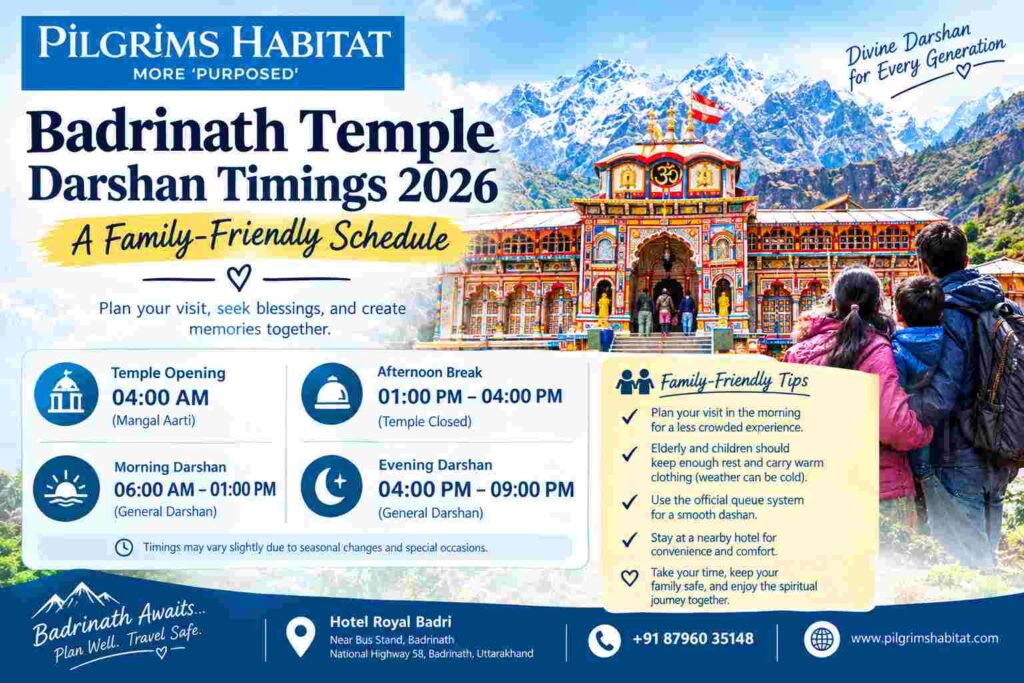 23 Sep 2026 UncategorizedBadrinath Temple Darshan Timings 2026: A Family-Friendly Schedule
 -
 22 Sep 2026 UncategorizedBest Place to Stay in Badrinath for Pilgrims With Health Conditions (2026)
 -
 21 Sep 2026 Badrinath HotelsBadrinath Hotel Amenities Families Actually Need (2026 Checklist)
 -
 19 Sep 2026 UncategorizedStay Near Temple in Badrinath: Why Walking Distance Matters Most After 60
 -
 18 Sep 2026 Badrinath Travel GuideBadrinath Hotel Contact and Booking Help for Elderly Pilgrims Travelling Alone (2026)