

How to Reach Badrinath: Road, Train, Air and Helicopter (2027 Guide)
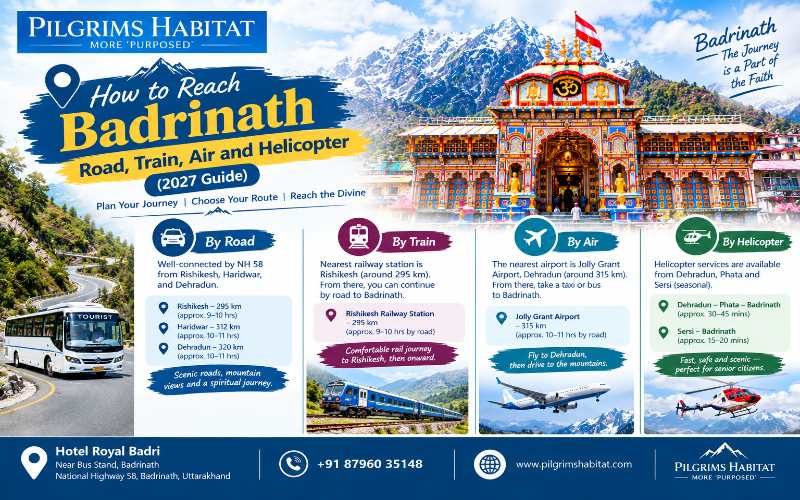
Badrinath can only be reached by road or helicopter. There’s no railway station or airport in the town. Most pilgrims take a train or flight to Haridwar, Rishikesh or Dehradun, then drive about 300 km up NH-7 along the Alaknanda, usually with an overnight halt on the way. The quickest option is a helicopter from Dehradun, which takes under an hour when the weather allows.
That’s the short answer. The rest of this guide covers every way in, how long each takes, and which one suits your group.
Badrinath distance chart: how far is it from major cities?
Distances below are approximate road distances to Badrinath town. Drive times assume normal traffic and no landslide holds, which in the mountains is never guaranteed.
Starting point | Road distance | Typical drive time | Recommended plan |
|---|---|---|---|
Delhi | 525 to 545 km | 16 to 18 hours | Two days, overnight in Rishikesh or Haridwar |
Haridwar | 315 to 325 km | 10 to 12 hours | Two days, halt at Rudraprayag or Joshimath |
Rishikesh | 295 to 300 km | 10 to 11 hours | Two days, or one very long day |
Dehradun (Jolly Grant airport) | 315 to 320 km | 10 to 12 hours | Two days |
Kedarnath (via Sonprayag) | 215 to 245 km by road | 7 to 9 hours from Sonprayag | One day after the Kedarnath trek |
Joshimath | About 45 km | 1.5 to 2 hours | Final leg, start by mid-morning |
Our rule of thumb: any plan that has you driving the Joshimath to Badrinath stretch after dark needs another night added. The road is narrow, the drops are steep, and if there’s a hold for slope clearance you want daylight on your side.
The Badrinath route by road, town by town

Every road route to Badrinath ends up on the same highway. From Rishikesh you follow NH-7 (the old NH-58) along the Ganga and then the Alaknanda through these towns:
- Rishikesh to Devprayag (about 70 km): the first confluence, where the Bhagirathi meets the Alaknanda to form the Ganga.
- Devprayag to Srinagar (about 35 km): a large town with hotels, ATMs and fuel. A common first-night halt.
- Srinagar to Rudraprayag (about 35 km): the junction where the Kedarnath road splits off.
- Rudraprayag to Karnaprayag (about 33 km), then Nandprayag and Chamoli.
- Chamoli to Joshimath (about 52 km): passing Pipalkoti, another useful halt.
- Joshimath to Badrinath (about 45 km): the last climb, through Vishnuprayag, Govindghat and Hanuman Chatti.
Five of those towns sit on the Panch Prayag, the five sacred river confluences. You’ll pass all of them, so it’s worth stopping at one or two if your schedule allows.
Can we take our own car to Badrinath?
Yes. Private cars drive right up to Badrinath and park in the town. The road is a paved national highway the whole way, though some stretches are narrow and broken after the monsoon. Three things matter more than the car:
- The driver. If you’re not used to hill driving, hire a local driver from Rishikesh or Haridwar. Hill drivers know where the slide zones are and when to wait.
- Fuel. Fill up at Joshimath. Pumps beyond it are few.
- Parking. Space near the temple lanes is limited in peak weeks. Hotels on the main road with their own parking, like ours near the bus stand, save a lot of circling.
For a full leg-by-leg plan from the capital, read our Delhi to Badrinath road guide.
Can we go to Badrinath by bus?
Yes. Uttarakhand Transport Corporation (UTC) buses and private operators, including the Tehri Garhwal motor owners’ cooperative, run from Rishikesh and Haridwar to Badrinath during the yatra season. Booking platforms list around ten departures a day from Rishikesh, almost all leaving between about 4 am and 8 am, with a journey of 10 to 12 hours. Fares range from roughly ₹675 for an ordinary seat to about ₹3,000 on premium coaches.
The catch is timing. If you miss the morning departures, there’s no evening bus. And buses don’t wait out long landslide holds the way a private taxi can.
Taxi and cab costs
Most families hire a taxi for the whole trip. Indicative fares quoted by Char Dham taxi operators for the 2026 season:
Vehicle | Rishikesh/Haridwar to Badrinath, one way | Round trip |
|---|---|---|
Sedan (Dzire, Etios) | ₹6,200 to ₹8,000 | ₹12,000 to ₹16,000 |
SUV (Ertiga, Bolero) | ₹8,200 to ₹11,000 | ₹16,000 to ₹22,000 |
Innova / Innova Crysta | ₹9,200 to ₹13,000 | ₹18,000 to ₹26,000 |
Tempo Traveller (10 to 12 seats) | ₹15,000 to ₹22,000 | On request |
Expect peak-week rates (May, June, festival days) to run 20% to 40% higher. Always confirm whether tolls, state entry tax and the driver’s allowance are included.
Reaching Badrinath by train
There’s no train to Badrinath yet. The nearest railheads are:
- Rishikesh (RKSH) and Yog Nagari Rishikesh (YNRK): about 295 km from Badrinath.
- Haridwar Junction (HW): about 320 km, with far more trains from Delhi and the rest of India.
- Dehradun (DDN): about 330 to 340 km.
For most pilgrims, Haridwar is the practical choice. The Delhi to Dehradun Shatabdi, the Jan Shatabdi, the Vande Bharat and the overnight Mussoorie Express all stop there. From the station, you continue by bus or taxi.
The Rishikesh to Karnaprayag rail line is under construction. When it opens, it will replace about 125 km of the road journey, saving several hours. As of 2026 there’s no confirmed opening date, so don’t plan around it yet. Our guide to Delhi to Badrinath by train lists trains, stations and onward connections.
Reaching Badrinath by air

The nearest airport is Jolly Grant Airport, Dehradun (DED), about 315 km from Badrinath by road and about 25 km from Rishikesh. It has direct flights from Delhi, Mumbai, Bengaluru, Hyderabad and several other cities.
From Jolly Grant you have two choices: drive (two days, same route as above), or take a helicopter from Dehradun’s Sahastradhara helipad to Badrinath.
Badrinath by helicopter
Helicopter services fly from Dehradun (Sahastradhara) to the Badrinath helipad in roughly 45 to 60 minutes. The helipad is close to the town. Fares for 2026 were quoted at roughly ₹7,500 to ₹15,000 one way depending on operator and season, with full packages costing more. Flights depend completely on weather, and morning cloud often causes delays.
Two warnings. You need your Char Dham registration before booking, and fake helicopter booking websites are common in the yatra season. Book only through operators listed by UCADA (Uttarakhand Civil Aviation Development Authority) or their official sites. More detail in our guide to the Badrinath helicopter and nearest airport.
Coming from Kedarnath
Most pilgrims do Kedarnath first and Badrinath second. After the trek back down to Gaurikund and Sonprayag, there are two road routes to Badrinath:
- Via Rudraprayag (about 224 km from Sonprayag): the main highway, with more buses and services.
- Via Ukhimath, Chopta and Gopeshwar (about 211 km): shorter, very scenic, but narrower and colder.
Both take 7 to 9 hours. Our Kedarnath and Badrinath itinerary lays out the full day plan.
Where to halt on the way
You’ll need at least one night between the plains and Badrinath. The best halt depends on your start time:
- Srinagar (Garhwal) if you leave Rishikesh after 9 am. Good hotels, river views, around 4 hours in.
- Rudraprayag if you leave by 7 am. Puts you within a day of Badrinath with daylight to spare.
- Pipalkoti or Joshimath if you leave at dawn and want a short final morning.
Some families stay in Joshimath and drive up and down for darshan. It works, but it adds 3 to 4 hours of driving per visit. We compare the two in Badrinath vs Joshimath stay.
Before you set off: documents and checks

- Char Dham registration is compulsory for every pilgrim. Register online before travel and carry the QR e-pass. See our Char Dham registration guide.
- Road status. After heavy rain, call the district disaster control room (1077 from within the district) or check the Chamoli police updates before leaving Joshimath. Our monsoon road safety guide explains how closures work.
- Cash. Carry enough for two to three days. ATMs are few above Joshimath.
- Warm layers. Even in June, Badrinath mornings can drop below 10°C.
Badrinath kaise jaye?
Badrinath jaane ke liye pehle Haridwar, Rishikesh ya Dehradun pahunchiye. Delhi se train ya flight sabse aasaan hai. Wahan se bus ya taxi se lagbhag 300 km ka pahadi safar hai, jo do din mein karna behtar hai. Raat mein Srinagar, Rudraprayag ya Joshimath mein rukiye. Jaldi pahunchna hai toh Dehradun se helicopter bhi milta hai. Yatra registration zaroor karwaiye.
Frequently Asked Questions
Take a train or flight from Delhi to Haridwar, Rishikesh or Dehradun, then travel about 300 km by road to Badrinath. The full road journey from Delhi is around 525 to 545 km. Most families split it over two days with a night in Rishikesh, Srinagar or Rudraprayag.
Rishikesh and Yog Nagari Rishikesh are the nearest railway stations, about 295 km from Badrinath. Haridwar Junction, about 320 km away, has many more trains from Delhi and other cities, so most pilgrims use Haridwar and continue by bus or taxi.
Jolly Grant Airport in Dehradun is the nearest airport, about 315 km from Badrinath by road. From there you can drive for two days via Rishikesh or take a helicopter from Dehradun’s Sahastradhara helipad to Badrinath in under an hour, weather permitting.
Yes. Private cars can drive all the way to Badrinath on the national highway and park in town. Hire an experienced hill driver if you’re new to mountain roads, refuel at Joshimath, and avoid driving the last 45 km from Joshimath after dark.
Yes. UTC and private operators run buses from Rishikesh and Haridwar to Badrinath in the yatra season. Departures leave early, mostly between 4 am and 8 am, and take 10 to 12 hours. Book a day ahead in peak weeks, as morning buses fill quickly.
Plan two days from Delhi, Haridwar or Rishikesh, with one overnight halt. Driving the whole way in one day is possible from Rishikesh but tiring, and it risks reaching the final mountain stretch after dark if there are traffic or landslide holds.
The road is open most of the year up to Joshimath, but Badrinath itself closes for winter when the temple shuts in November. The highway near Badrinath gets heavy snow until spring. During the monsoon, landslides can close sections for hours or, occasionally, days.
Yes. Helicopters fly from Dehradun’s Sahastradhara helipad to Badrinath in about 45 to 60 minutes. Fares quoted for 2026 ranged roughly from ₹7,500 to ₹15,000 one way. Flights are weather-dependent, and you need Char Dham registration before booking.
Rudraprayag is the most practical halt for most families because it leaves a comfortable day’s drive to Badrinath. Srinagar suits late starters, and Pipalkoti or Joshimath suit those leaving Rishikesh at dawn who want a short final morning.
Yes. Char Dham Yatra registration is compulsory for all pilgrims visiting Badrinath. Register online on the Uttarakhand government portal before you travel and carry the QR-code e-pass. Offline counters operate in Haridwar and Rishikesh, but queues can be long in peak season.
All Categories
Recent Post
-
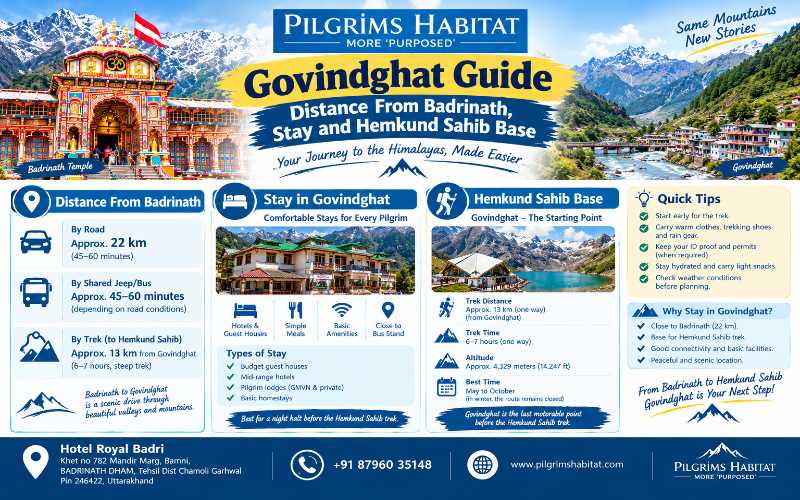 26 Oct 2026 UncategorizedGovindghat Guide: Distance From Badrinath, Stay and Hemkund Sahib Base
-
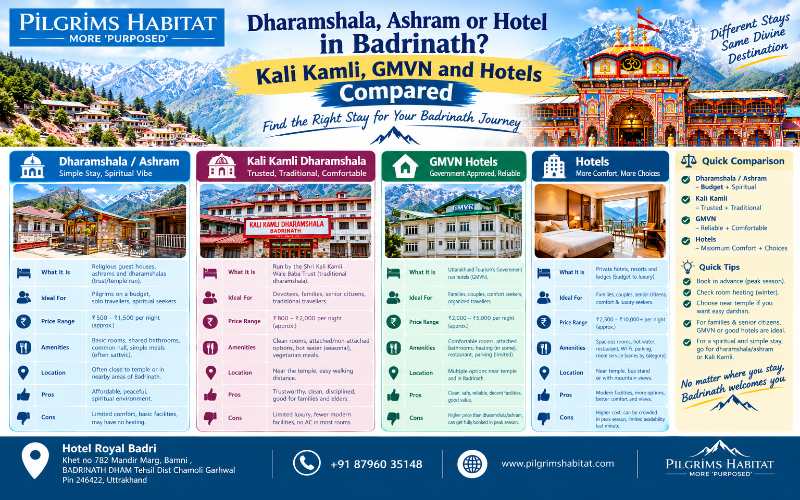 23 Oct 2026 UncategorizedDharamshala, Ashram or Hotel in Badrinath? Kali Kamli, GMVN and Hotels Compared
-
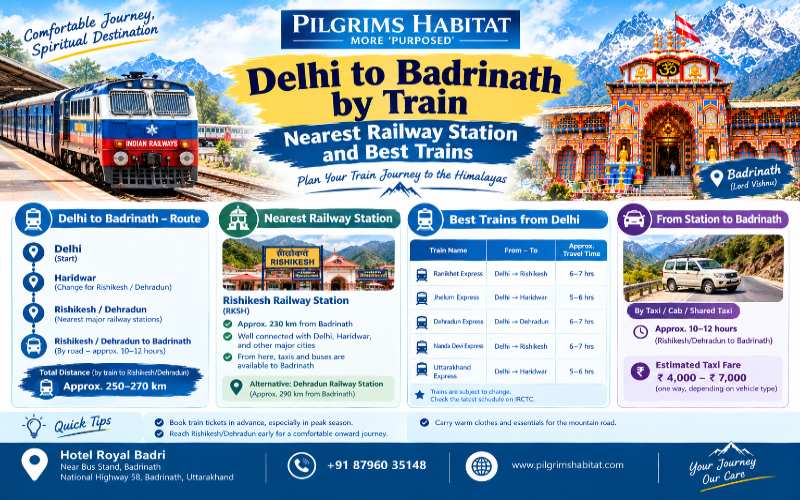 22 Oct 2026 UncategorizedDelhi to Badrinath by Train: Nearest Railway Station and Best Trains
-
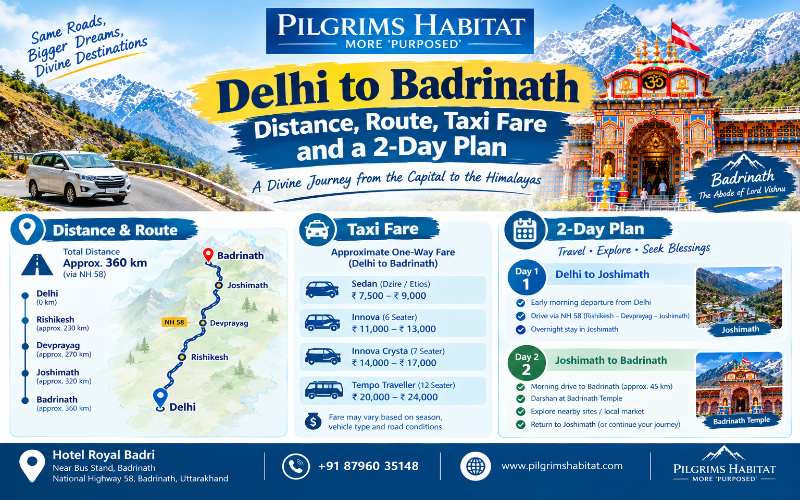 21 Oct 2026 UncategorizedDelhi to Badrinath: Distance, Route, Taxi Fare and a 2-Day Plan
-
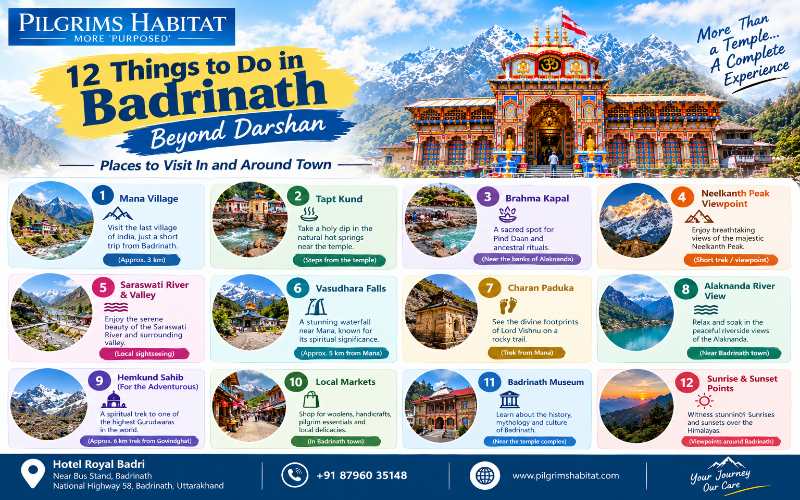 19 Oct 2026 Uncategorized12 Things to Do in Badrinath Beyond Darshan: Places to Visit In and Around Town
Plan the last 300 km with us
Hotel Royal Badri sits on the main road near the Badrinath bus stand, about 900 m from the temple, with parking for cars and taxis and a front desk used to late arrivals after long drives. See rooms at Hotel Royal Badri or WhatsApp +91 87960 35148 with your route and dates. We’ll tell you where to halt and when to leave Joshimath.

4 Responses