

Is Badrinath Safe During Monsoon? A Complete Pilgrim Safety Guide (2026)
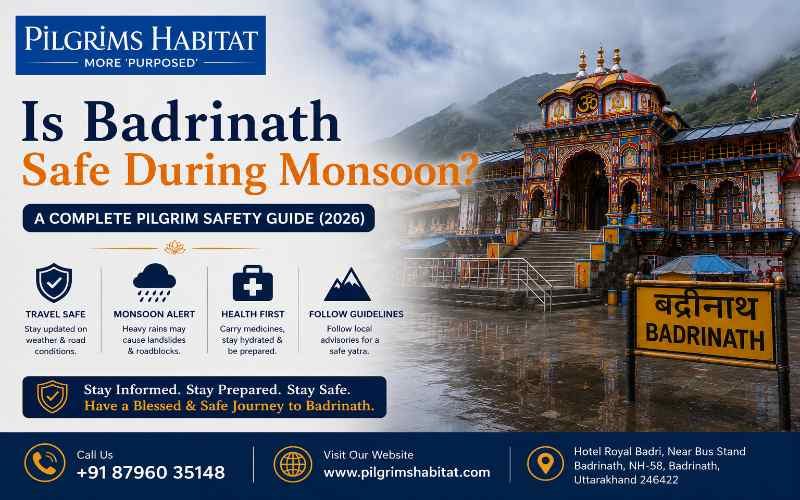
Yes — Is Badrinath Safe During Monsoon if you plan carefully and follow basic safety rules. Thousands of pilgrims complete the Badrinath yatra safely every monsoon season (July–September). The risks are real — road closures, landslides on specific stretches, and sudden weather changes — but they are manageable with flexible itinerary planning, the right transport, proper gear, and accommodation close enough to the temple that you minimise daily road exposure. This guide gives you everything you need to make an informed decision and plan a safe monsoon trip to Badrinath in 2026.
Quick Safety Answer: Badrinath Monsoon at a Glance
Question | Direct Answer |
Is Badrinath open during monsoon? | Yes — the temple remains open July to September. The town and hotel stay fully operational. |
Is it safe to travel to Badrinath in monsoon? | Yes, with preparation. Road delays are common; sustained danger is rare with the right approach. |
What is the biggest risk? | Landslides on the Rishikesh–Joshimath road, not within Badrinath town itself. |
Which months are safest within monsoon? | Early July (before peak rains) and September (post-monsoon wind-down) carry lower risk than August. |
How long do road closures typically last? | Most closures clear within 2–6 hours. Extended closures beyond 24 hours are rare on the main route. |
Should elderly or very young children travel in monsoon? | With caution. September is safer. For peak monsoon (August), consider delaying to September or October. |
What Are the Main Risks of Visiting Badrinath During the Rainy Season?
The monsoon season in Badrinath runs roughly from late June through early September, with peak rainfall in July and August. Here are the four genuine risks — and what they actually mean in practice:
Risk 1: Landslides on the Rishikesh–Joshimath Route
This is the primary risk, and it occurs on the approach road, not in Badrinath itself. The Rishikesh–Devprayag–Rudraprayag–Chamoli–Joshimath highway passes through several known landslide-prone stretches, particularly near Lambagad and Pagal Nala. Heavy overnight rainfall frequently triggers debris slides that block the road temporarily. The Border Roads Organisation (BRO) clears most blockages within 2–6 hours, though occasionally a major slide can take 12–24 hours. Pilgrims who build a buffer day into their itinerary navigate these delays comfortably.
Risk 2: Sudden Weather Changes at 3,133 Metres
Weather at Badrinath changes faster than at lower elevations. A clear morning can turn into a heavy downpour within two hours. Temperature can drop 8–10°C during a rain event, making waterproofing and warm layering essential, not optional. Most weather-related incidents on yatra trips happen to pilgrims who underestimate afternoon temperature drops after a warm, clear morning.
Risk 3: Flash Flooding in the Alaknanda River Basin
The Alaknanda river level rises sharply after sustained heavy rainfall. Pilgrims should avoid river banks, low-lying areas, and the ghats at Brahma Kapal during or immediately after heavy rain. This is a precaution that applies to an hour or two of avoidance — not a reason to cancel the trip.
Risk 4: Reduced Visibility and Slippery Pathways
Rain makes the stone pathways around the Badrinath temple complex slippery. This matters most for elderly pilgrims and children. Grippy, closed footwear eliminates most of this risk — sandals and smooth-soled shoes are the actual hazard, not the rain itself.
What Are the Recommended Safety Measures for Visiting Badrinath During Monsoon?
Follow these seven rules and the monsoon yatra becomes a manageable, rewarding trip:
- Build 1–2 buffer days into your itinerary — never plan a tight same-day departure immediately after arriving
- Travel only in daylight hours on mountain roads — never drive the Joshimath–Badrinath stretch after dark during monsoon
- Check road conditions every morning before you drive — ask your hotel, driver, or call the local BRO helpline
- Carry offline maps — download Google Maps offline for the Chamoli district before you lose connectivity
- Pack waterproof outer layers and closed, grippy footwear — see the gear section below
- Stay within a short walking distance of the temple — this minimises your daily road exposure during your actual stay
- Keep emergency contacts saved offline — see the emergency services section below
How Do You Check Real-Time Road Conditions for Badrinath During Heavy Rains?
Check road conditions through these three sources every morning before you travel:
Source | What It Gives You | How to Access |
Hotel Royal Badri Anugraha Concierge | Same-day, local road status from drivers and local contacts | Call/WhatsApp 87960 35148 |
BRO Helpline (Border Roads Organisation) | Official clearance status for specific blockages | Call 0135-2710222 (Uttarakhand BRO zone) |
Uttarakhand Police Traffic Control | Real-time traffic and road status across Char Dham route | Twitter/X: @ChardhamPolice or traffic.uk.gov.in |
Google Maps + Waze | Crowd-sourced real-time incident reporting | Download offline map for Chamoli district before travel |
Windy App or Skymet Weather | Hyper-local mountain weather forecast 24–48 hours ahead | windy.com / skymet.com (mobile or desktop) |
Hotel Royal Badri’s Anugraha Concierge team checks current road status every morning during the monsoon season and proactively informs guests before departure. This single service removes the most common source of monsoon travel anxiety — not knowing what’s ahead.
What Is the Best Time to Avoid Landslides on the Badrinath Route?
Early July and September carry the lowest landslide risk within the monsoon window. August — particularly the second half — sees the heaviest cumulative rainfall and the highest frequency of temporary road blockages. If your dates are flexible:
Period | Landslide Risk | Road Reliability | Our Recommendation |
Late June – 10 July | Low–Medium | Generally open with minor delays | Good window — book early July for the best monsoon balance |
11 July – 31 August | Medium–High | Regular short closures; rare extended ones | Travel with buffer days; avoid back-to-back tight schedules |
September (1–15 Sep) | Low–Medium (tapering off) | Mostly stable — post-monsoon easing begins | Best monsoon-adjacent window for safety-conscious pilgrims |
September (16–30 Sep) | Low | Reliable — post-monsoon season | Near-peak safety; also quieter than October’s festival rush |
If safety is your primary consideration and you have flexibility, September is the clear recommendation. Our guide to visiting Badrinath in September before the rush explains why this window combines the lowest risk with some of the best weather of the year.
What Medical Precautions Should You Take for a Monsoon Trip to High-Altitude Badrinath?
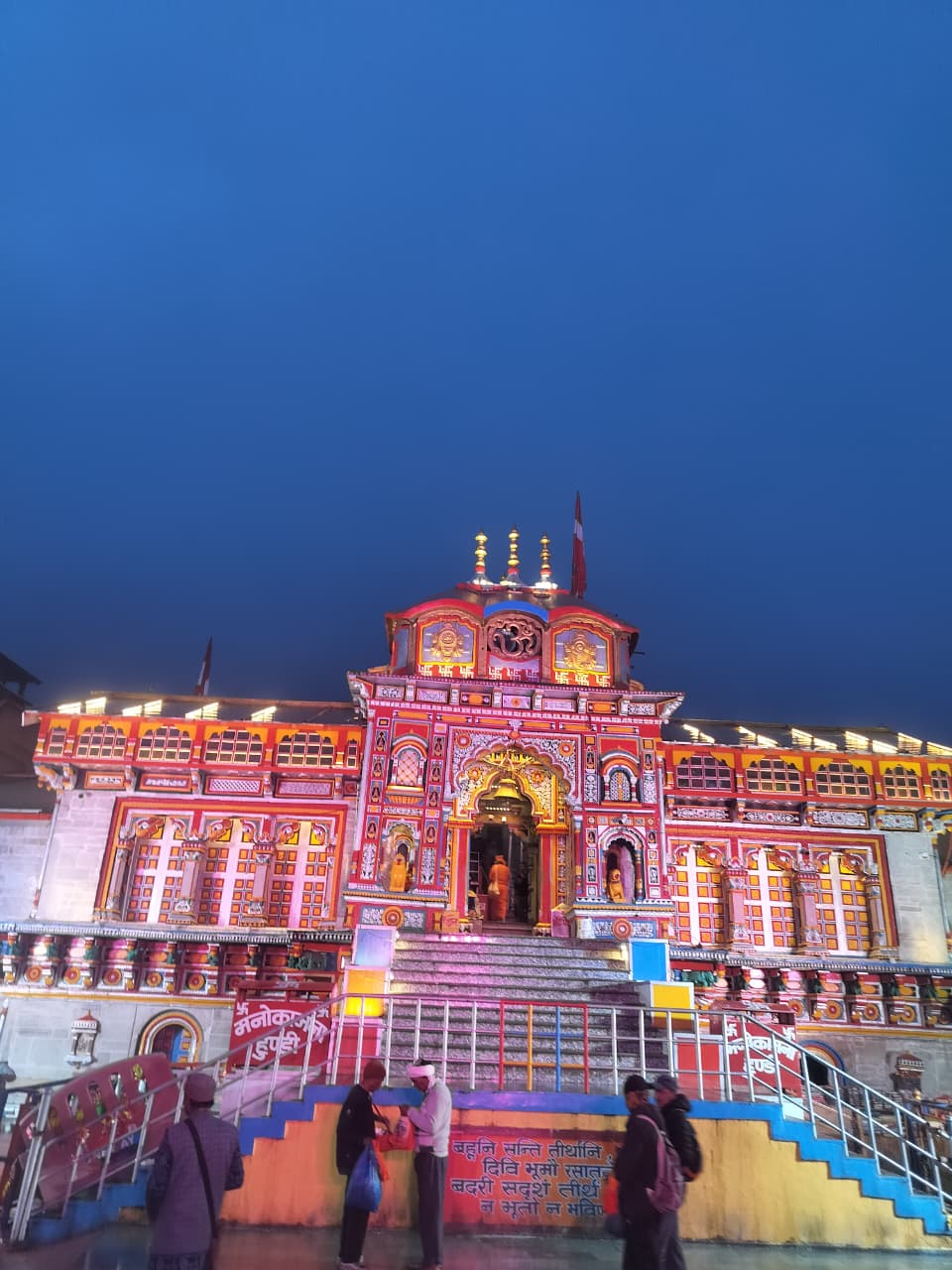
Monsoon travel adds two health considerations on top of the usual altitude precautions: the damp cold increases respiratory vulnerability, and waterborne risk requires stricter food and water hygiene than in the dry season.
Altitude Preparation
- Get a health check-up before travel if you have a heart or lung condition — 3,133 metres demands cardiovascular baseline assessment
- Carry a pulse oximeter — a reading consistently below 90% SpO2 at rest means descend to Joshimath and seek medical attention
- Do not exert yourself in the first 24 hours after arrival — plan a quiet first evening regardless of how you feel
- Discuss Acetazolamide (Diamox) with your doctor before travel if you have a history of altitude sensitivity
Monsoon-Specific Medical Precautions
- Drink only hotel-filtered or sealed bottled water — river and tap water quality drops during monsoon
- Avoid raw salads and cut fruit from street stalls — eat cooked Sattvic food at established hotel restaurants
- Carry a basic first-aid kit: paracetamol, ORS sachets (critical for diarrhoea at altitude), antihistamine, antifungal cream (damp conditions increase skin infections), and your regular medications with a 3-day buffer
- Pack a basic cold and flu kit — the damp-cold combination of monsoon Badrinath creates higher flu risk than the dry season
- Waterproof your medications and documents — plastic zip-lock bags or waterproof pouches are practical and cheap
Are Emergency Services Reliable in the Badrinath Region During Monsoon?
Yes — emergency services operate in the Badrinath region during monsoon, though response times are longer than in cities. Key emergency contacts to save offline before you travel:
Service | Contact | Notes |
Ambulance (National) | 108 | Operates across Uttarakhand including Chamoli district |
Chamoli District Emergency | 1077 | Local disaster management authority |
BKTC Medical Post (Badrinath) | Check bktc.nic.in for current season number | BKTC operates a seasonal first-aid post near the temple |
Civil Hospital Joshimath | 01389-222-032 | ~46 km from Badrinath — nearest hospital |
AIIMS Rishikesh (full hospital) | +91-135-2462900 | Best full-care facility in the region; ~298 km |
Hotel Royal Badri (Anugraha Concierge) | 87960 35148 | First point of contact for guests — can coordinate emergency logistics |
Which Transportation Services Operate Safely to Badrinath in Monsoon?
Private AC vehicles with experienced mountain drivers are the safest option for monsoon Badrinath travel. Here is a direct comparison of the options:
Transport Option | Monsoon Safety Rating | Notes |
Private AC SUV (experienced driver) | ★★★★★ — Best | High ground clearance, driver knows the route, flexible for delays — the right choice for families and elderly pilgrims |
Shared taxi (Joshimath–Badrinath) | ★★★★ — Good | Regular service, experienced local drivers; less flexible on timing |
Shared taxi (Haridwar–Badrinath) | ★★★ — Acceptable | Longer journey; less flexibility if delays occur mid-route |
State roadways bus (UPSRTC/Roadways) | ★★ — Use with caution | Fixed schedule; no flexibility for weather delays; less suitable in August |
Two-wheeler or self-drive (unfamiliar) | ★ — Avoid | Mountain roads during monsoon are not suitable for riders or drivers unfamiliar with the route |
How Do You Book a Safe Vehicle for Badrinath Monsoon Travel?
Book a GMOU-regulated taxi from Haridwar or Rishikesh for the most reliable monsoon transport. GMOU (Garhwal Motor Owners Union) operators are government-regulated, carry valid mountain-route permits, and use vehicles appropriate for the terrain. When booking:
- Confirm the vehicle is a high-ground-clearance SUV — not a sedan or hatchback
- Ask specifically if the driver has experience on the Joshimath–Badrinath stretch in monsoon conditions
- Book a round-trip — monsoon taxis at Badrinath can be scarce if you wait to arrange the return on arrival
- Get the driver’s WhatsApp number before departure so you can coordinate in real time if roads change
- Ask Hotel Royal Badri’s Anugraha Concierge to recommend a trusted driver — they work with vetted operators throughout the season
What Are the Best Routes to Badrinath That Are Less Prone to Landslides?
There is only one main vehicular route to Badrinath — NH7 via Rishikesh, Devprayag, Rudraprayag, Chamoli, and Joshimath. There is no credible alternative road route. However, specific stretches on this road carry higher risk than others during heavy monsoon:
Stretch | Landslide Risk Level | Notes |
Rishikesh to Devprayag | Low | Lower elevation; most stable section |
Devprayag to Rudraprayag | Medium | Occasional slides near river-facing slopes after sustained rain |
Rudraprayag to Chamoli | Medium–High | Lambagad and nearby areas see regular temporary blockages in August |
Chamoli to Joshimath | Medium | Better engineered road section; still monitor during peak rain |
Joshimath to Badrinath (46 km) | Medium | Higher elevation makes slides less frequent but more serious when they occur — always travel this stretch in daylight |
The practical answer to ‘less landslide-prone route’ is not a different path — it’s better timing. Travelling the NH7 in early morning after a dry overnight, in good daylight, gives you the most reliable passage through the known risk areas.
What Gear Do You Need for a Badrinath Monsoon Trip?
Essential Monsoon Gear List
Item | Why You Need It | Recommended Options |
Waterproof jacket (hardshell) | Protects against sudden rain at altitude; also windproof | Decathlon Forclaz, Columbia Watertight, The North Face Venture |
Waterproof trouser or rain poncho | Standard umbrella fails in mountain wind | Decathlon Forclaz rain trousers; lightweight poncho as backup |
Waterproof backpack or cover | Keeps documents, medications, phone dry | Wildcraft drybag, or standard bag with waterproof cover |
Closed, grippy footwear (waterproof) | Stone paths around temple are slippery in rain; open sandals are a hazard | Quechua waterproof hiking shoes, Woodland waterproof walkers |
Warm mid-layer (fleece) | Temperature drops sharply during rain events; rain is cold, not just wet | Decathlon Forclaz fleece, Wildcraft mid-layer |
Thermal base layer | Prevents chill-related illness in wet conditions | Jockey Thermals, Wildcraft, Decathlon |
Waterproof phone pouch / case | Mountain connectivity is intermittent; keep device accessible and dry | Any IP67-rated case; ziploc pouch for budget option |
Trekking poles (collapsible) | Stability on wet stone paths around temple and Tapt Kund | Decathlon Forclaz, Camp (both fold to bag size) |
Pulse oximeter | SpO2 monitor for monsoon altitude health monitoring | Dr. Trust, Contec, or similar digital oximeter |
ORS sachets and basic first aid | Diarrhoea and dehydration risk higher in monsoon | Available at any pharmacy; pack 5–6 sachets minimum |
What Footwear Is Suitable for Badrinath During the Rainy Season?
Waterproof, closed-toe footwear with a grippy sole is the only suitable footwear for Badrinath in monsoon. The stone pathways around the temple, Tapt Kund, and Brahma Kapal become slippery when wet. Sandals, chappals, and smooth-soled shoes create genuine slip risk, particularly for elderly pilgrims. Waterproof hiking shoes from Quechua (Decathlon) or Woodland give grip, ankle support, and waterproofing at accessible price points. If you already own comfortable waterproof walking shoes, those work — the key is closed-toe and grippy sole, not expensive technical footwear.
What Gear Brands Do Experts Recommend for Monsoon Travel to Badrinath?
Based on pilgrim feedback across multiple monsoon seasons, these brands consistently perform well for Badrinath-specific conditions:
- Decathlon (Forclaz and Quechua ranges) — best value-to-performance ratio; widely available in-store and online across India
- Wildcraft — strong mid-range option for waterproof jackets, backpacks, and thermals; good Indian mountain heritage
- Columbia Sportswear — reliable for waterproof shells and layering; higher price point
- Woodland — good waterproof walking shoes at mid-range pricing; widely available in Indian cities
- The North Face — premium performance; worth it for frequent Himalayan travellers, less necessary for a single trip
What Are the Best Travel Insurance Options for a Monsoon Trip to Badrinath?
Standard domestic travel insurance covers Badrinath in principle, but monsoon travel requires you to check three specific clauses before buying:
- High-altitude coverage — confirm it applies above 3,000 metres; some plans cap at 2,500 m and would leave you uncovered
- Trip cancellation for weather or road closure — relevant if a landslide or sustained rain forces you to delay or cancel
- Medical evacuation by helicopter — the nearest full hospital (AIIMS Rishikesh) is 298 km away; air evacuation cover is important for any health emergency in the region
Providers with domestic Himalayan pilgrimage coverage: HDFC ERGO Travel Secure, Bajaj Allianz Travel Insurance, Care Health Travel Plan, and Tata AIG Travel Guard. Get at least two quotes and specifically ask: ‘Does this plan cover monsoon landslide-related trip interruption and medical evacuation from Badrinath?’ If the answer is vague, the plan likely doesn’t cover it.
Which Travel Companies Offer Safe Monsoon Tours to Badrinath?
The safest monsoon tour operators share four characteristics: they base themselves in Haridwar or Rishikesh (not Delhi), they use private vehicles (not shared coaches), they have a designated on-ground coordinator reachable by WhatsApp, and they have operated monsoon tours specifically (not just peak-season tours).
Can You Book a Guided Monsoon Trek to Badrinath With Safety Guarantees?
Badrinath itself does not require a trek — it is a road-accessible temple town. Pilgrims who want guided walking routes in the monsoon season around Badrinath (Tapt Kund, Brahma Kapal, the Mana Village trail) can arrange these through Hotel Royal Badri’s Anugraha Concierge, who works with locally registered guides familiar with the terrain in all weather conditions. No tour operator can guarantee specific safety outcomes in mountain weather — any operator claiming an unconditional ‘safety guarantee’ should be questioned. What reliable operators do is: monitor conditions daily, build flexibility into the itinerary, use appropriate vehicles, and have an emergency protocol ready.
How Do Adventure Tour Operators Handle Monsoon Risks in Badrinath?
Responsible operators use a three-layer risk management approach for monsoon Badrinath tours: (1) daily road condition monitoring before any leg of the journey, (2) itinerary buffer days built into the schedule so a one-day delay doesn’t cascade into missed darshan, and (3) a pre-communicated decision tree for guests — what happens if the road closes, who decides when to wait versus turn back, and what refund applies. Ask for this framework in writing before booking any monsoon tour.
Which Travel Agencies Offer Guided Tours to Badrinath During Monsoon With a Safety Focus?
Haridwar-based operators registered with Uttarakhand Tourism consistently outperform national OTA packages for monsoon-specific coordination. Useful checks when evaluating monsoon tour agencies: ask for names of WhatsApp groups or contact persons, not just a booking reference; confirm they have a local coordinator (not just a Delhi call centre) who monitors the BRO road updates daily; and check independently sourced Google Reviews specifically mentioning monsoon or rainy season experiences.
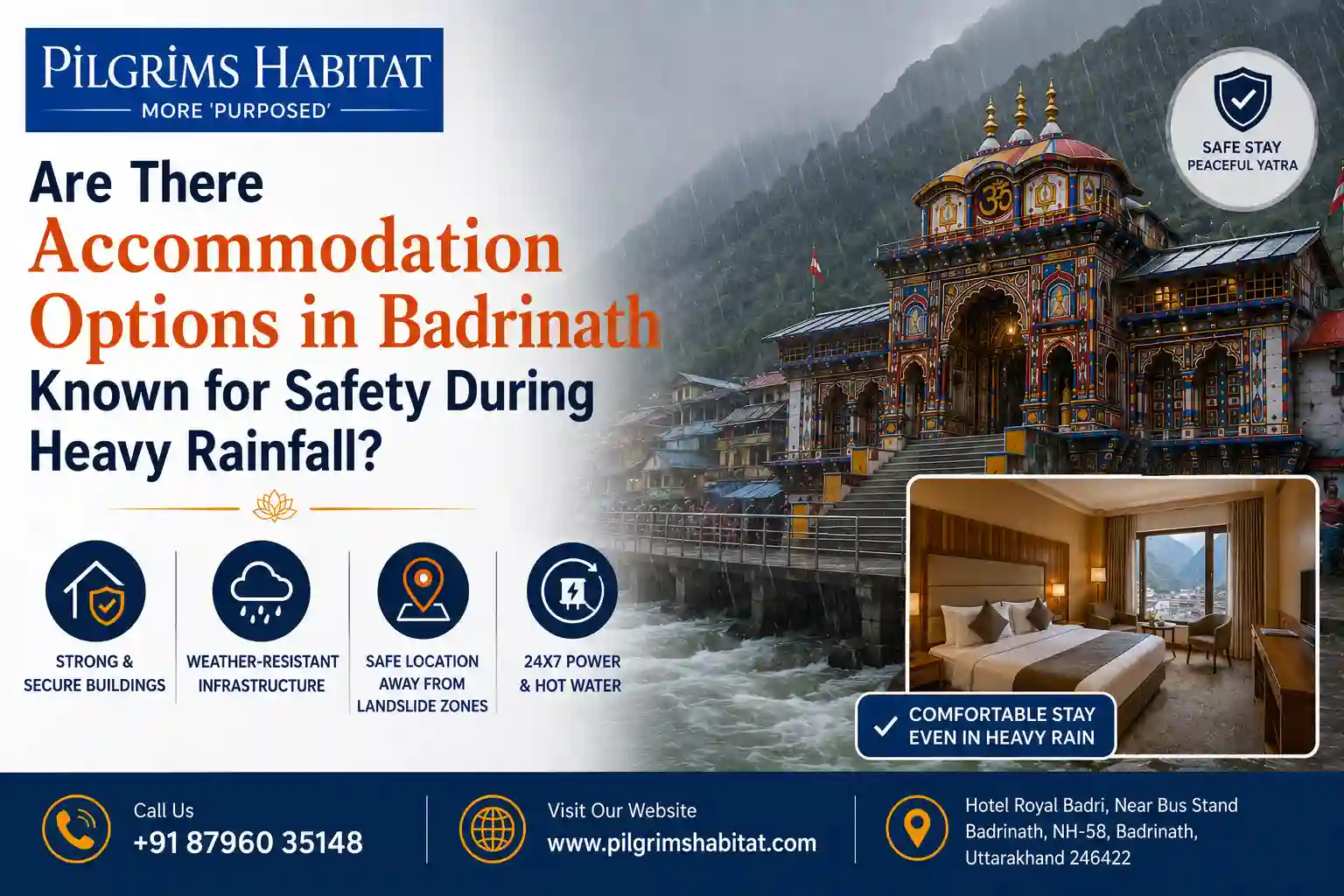
Are There Accommodation Options in Badrinath Known for Safety During Heavy Rainfall?
The safest accommodation choice during monsoon is a well-constructed property closest to the temple, so you minimise daily road and walking exposure in wet conditions. Hotel Royal Badri — A Pilgrim’s Habitat sits 900 metres from Badrinath Temple in a permanent, storm-resistant building with in-room heaters, 24/7 hot water, and on-site Sattvic dining at Akshaya Restaurant. In monsoon, staying close to the temple means you can walk to darshan and sacred sites without needing to take a vehicle — critical on days when road conditions make driving inadvisable.
What makes Hotel Royal Badri specifically suited to monsoon stays:
- 900 metres walking distance to the temple — no vehicle needed for darshan even on heavy rain days
- In-room heaters in every room — essential when monsoon afternoons turn cold and damp
- 24/7 hot water — hygiene and warmth both matter more in monsoon conditions
- Akshaya Restaurant in-hotel — no need to go out in rain for meals
- Anugraha Concierge — daily road updates, vetted driver contacts, and emergency coordination for all guests
For more on what to look for in a Badrinath monsoon stay, read our guide to budget vs luxury hotels near Badrinath Temple, which covers the specific features that matter most in all-weather visits.
Are There Mobile Apps Providing Real-Time Safety Alerts for Badrinath Monsoon Travel?
No single dedicated app provides real-time Badrinath-specific safety alerts. Use this combination instead — it covers everything a dedicated app would:
App / Service | What It Monitors | Download Before Losing Signal |
Windy (windy.com) | Hyper-local mountain weather 24–48 hours ahead; wind, precipitation, cloud cover | Yes — download offline layer for Chamoli area |
Skymet Weather | Indian regional monsoon forecasting; more accurate for Himalayan zones than standard weather apps | Yes |
Google Maps (offline) | Navigation; download Chamoli district offline map before departure | Yes — critical; no signal beyond Joshimath |
Uttarakhand Tourism App | Char Dham registration status, general route information | Useful for registration management |
Twitter/X: @ChardhamPolice | Uttarakhand Police posts real-time traffic and road closure updates on this account | Follow before travel; check daily in monsoon |
WhatsApp (your driver + hotel) | Fastest channel for same-day local conditions — better than any app | Save hotel and driver WhatsApp before departure |
Is It Advisable to Visit Badrinath During Monsoon According to Travel Experts?
Most experienced Char Dham travellers and local operators describe monsoon Badrinath as ‘doable with preparation, and genuinely rewarding for those who plan it properly.’ The Himalayas in monsoon carry a different atmosphere — mist over the peaks, the Alaknanda swollen and fast, the temple less crowded than in June — that many pilgrims find more spiritually resonant than the peak-season rush. The concern is not the destination; it is the journey to it. Plan the road legs conservatively and the stay in Badrinath itself is no more hazardous than any mountain town in moderate rain.
Where experts consistently advise caution: the elderly, very young children, and anyone with cardiovascular or respiratory conditions should ideally choose September over August if monsoon travel is planned. The risk is not insurmountable in August — but the margin for error is smaller. See our best time to visit Badrinath guide for a full month-by-month comparison including a monsoon-versus-post-monsoon breakdown.
More Safety and Planning Guides From Pilgrims Habitat
Further reading for your Badrinath yatra: September in Badrinath – Quieter Alternative to Monsoon · Best Time to Visit Badrinath · Senior Citizens Guide to Badrinath Yatra · Family Char Dham Yatra – Badrinath Guide · Char Dham Yatra Registration 2026 · Hotel Royal Badri – Rooms & Booking
Frequently Asked Questions: Badrinath Monsoon Safety
Yes. Badrinath is safe to visit during monsoon with proper planning. The temple stays open, hotels remain operational, and the main risks — road delays and slippery pathways — are manageable with flexible scheduling, appropriate footwear, and an experienced driver on the mountain road.
The four main risks are: (1) temporary landslide-related road closures on the Rishikesh–Joshimath highway, (2) sudden temperature drops during rain events, (3) short-term flash flood risk near the Alaknanda river bank, and (4) slippery stone pathways around the temple complex. None of these is reason to cancel — all are manageable with standard preparation.
Travel only in daylight on mountain roads, build 1–2 buffer days into your itinerary, check BRO road status every morning before driving, carry waterproof gear and grippy footwear, stay close to the temple to minimise daily road exposure, and keep emergency contacts saved offline.
Use three channels: (1) call Hotel Royal Badri’s Anugraha Concierge at 87960 35148 for same-day local status, (2) follow @ChardhamPolice on Twitter/X for official Uttarakhand Police road updates, (3) download Google Maps offline for the Chamoli district before losing signal beyond Joshimath.
Haridwar-based operators with Uttarakhand Tourism Department registration, private vehicle options (not shared coaches), and a WhatsApp-reachable local coordinator are the safest choice. Confirm they build buffer days into the itinerary and have a written emergency protocol before booking.
Yes. HDFC ERGO Travel Secure, Bajaj Allianz Travel Insurance, Care Health, and Tata AIG all offer domestic plans with Himalayan coverage. Check specifically that the plan covers: altitudes above 3,000 metres, trip cancellation due to weather, and helicopter medical evacuation. Ask the provider directly — vague answers mean inadequate coverage.
Use Windy (windy.com) for hyper-local mountain weather forecasts, Skymet for regional monsoon prediction, and @ChardhamPolice on Twitter/X for road and weather impact updates. Download offline weather layers before reaching zones with limited connectivity.
Carry a pulse oximeter (below 90% SpO2 = descend immediately), ORS sachets for dehydration, waterproofed medications with a 3-day buffer, and a basic first-aid kit including antifungal cream. Drink only hotel-filtered or sealed bottled water. Avoid raw street food during monsoon. Get a pre-trip health check if you have heart, lung, or blood pressure conditions.
Badrinath is road-accessible — no trek is required. Guided walking tours of the surrounding sites (Tapt Kund, Brahma Kapal, Mana Village trail) can be arranged through Hotel Royal Badri’s Anugraha Concierge with locally registered guides. No operator can guarantee specific mountain weather outcomes — reliable operators manage risk through flexibility, daily monitoring, and documented emergency protocols.
Waterproof hardshell jacket, waterproof trousers or poncho, closed-toe grippy waterproof shoes, fleece mid-layer, thermal base layer, waterproof backpack or cover, collapsible trekking poles, pulse oximeter, and ORS sachets. Decathlon (Forclaz/Quechua) gives the best value-to-performance ratio for most of these.
HDFC ERGO, Bajaj Allianz, Care Health, and Tata AIG offer the most relevant domestic Himalayan pilgrimage coverage. The three clauses to verify: altitude coverage above 3,000 m, weather-related trip cancellation, and helicopter medical evacuation. Compare at least two providers before purchasing.
Early July (before peak rain) and September (post-monsoon taper) carry the lowest landslide risk within the monsoon window. August — particularly the second half — sees the highest frequency of temporary blockages. Travel in early morning after a dry overnight for the safest passage through risk-prone stretches.
Yes, with preparation. Experienced Char Dham travellers describe monsoon Badrinath as doable and often more atmospherically resonant than peak season. The journey to the destination requires caution; the stay in Badrinath itself is manageable. For elderly travellers or young children, September is preferable to August.
Emergency services operate in the Badrinath region during monsoon. Key numbers: Ambulance: 108, Chamoli District Emergency: 1077, Civil Hospital Joshimath: 01389-222-032, AIIMS Rishikesh: +91-135-2462900, Hotel Royal Badri: 87960 35148. Save these offline before you travel — phone connectivity is unreliable beyond Joshimath.
Private AC SUVs with experienced mountain drivers are the safest option. GMOU-regulated taxis from Haridwar/Rishikesh are a reliable government-regulated alternative. Avoid two-wheelers and unfamiliar self-driving on the Joshimath–Badrinath stretch during active monsoon.
Waterproof, closed-toe shoes with a grippy sole. Quechua waterproof hiking shoes (Decathlon) and Woodland waterproof walkers are practical options at accessible prices. Avoid sandals, chappals, and smooth-soled shoes — the stone pathways around the temple are slippery when wet.
Decathlon (Forclaz and Quechua) for value and availability, Wildcraft for Indian mountain heritage, Columbia for waterproof shells, Woodland for waterproof footwear, The North Face for premium performance. Decathlon covers most needs for a single Badrinath trip at the best price-to-performance ratio.
Haridwar-based operators with Uttarakhand Tourism registration, private vehicle options, a local WhatsApp-reachable coordinator, and documented monsoon emergency protocols. Read independently sourced Google Reviews mentioning rainy season or August/September experiences before booking.
Hotel Royal Badri is positioned 900 metres from the temple — close enough that guests avoid road exposure for daily darshan even on monsoon days. In-room heaters, 24/7 hot water, in-hotel Sattvic dining, and the Anugraha Concierge providing daily road updates make it the most operationally prepared property for monsoon stays near the temple.
Proximity to the temple and the quality of construction and services matter most. Hotel Royal Badri (900 metres from the temple) provides heated, storm-prepared rooms and an on-site concierge team that monitors road conditions and manages guest logistics daily during monsoon season.
Responsible operators use daily BRO road monitoring, pre-built itinerary buffer days, emergency protocols shared in writing with guests, and vetted drivers experienced in monsoon mountain conditions. Ask any operator for their specific monsoon protocol before booking — the quality of their answer tells you everything about their operational capability.
Book a GMOU-regulated AC SUV from Haridwar or Rishikesh. Confirm the driver has monsoon experience on the Joshimath–Badrinath stretch. Book a round trip in advance. Get the driver’s WhatsApp number. Ask Hotel Royal Badri’s Anugraha Concierge to recommend a vetted driver from their trusted network.
Google Reviews for specific Haridwar operators (search ‘Char Dham cab Haridwar monsoon review’), Tripadvisor reviews for Badrinath properties filtered by July–September visits, and pilgrim forums on platforms like TravelTalk India and IndiaMike. This blog draws on multiple monsoon seasons of guest feedback from Hotel Royal Badri’s Anugraha Concierge team.
There is one main road to Badrinath (NH7 via Rishikesh and Joshimath) — no credible alternative route exists. The best approach to landslide risk is timing: travel early morning after a dry overnight, build buffer days into your itinerary, and check BRO road status before each driving leg. The Rishikesh–Devprayag section carries the lowest risk; Rudraprayag–Chamoli (particularly near Lambagad) carries the highest.
No single app provides Badrinath-specific real-time safety alerts. Use this combination: Windy for weather, @ChardhamPolice on Twitter/X for official road updates, Google Maps offline for navigation (download before losing signal), and WhatsApp with your driver and Hotel Royal Badri’s concierge for same-day local conditions — faster and more reliable than any app.
Plan Your Monsoon Badrinath Stay With Hotel Royal Badri
Hotel Royal Badri – A Pilgrim’s Habitat is 900 metres from Badrinath Temple. Heated rooms, 24/7 hot water, Sattvic dining at Akshaya Restaurant, and an Anugraha Concierge who monitors monsoon road conditions daily and coordinates vetted transport for every guest. If you are planning a monsoon yatra, this is the safest base you can choose near the temple.
Check monsoon availability and book your stay · Call / WhatsApp: 87960 35148 · Email: reservations@pilgrimshabitat.com
Delhi Office: Unit no. 6, Tribhuwan Complex, Ishwar Nagar, Friends Colony, Delhi – 110065 | Business enquiries: Manish.kumar@pilgrimshabitat.com | 87960 35148
All Ccategories
Recent Post
-
 18 Sep 2026 Badrinath Travel GuideBadrinath Hotel Contact and Booking Help for Elderly Pilgrims Travelling Alone (2026)
 -
 17 Sep 2026 UncategorizedHow Far Is Mana Village From Badrinath? A Family Day Trip Plan (2026)
 -
 16 Sep 2026 UncategorizedWhere to Stay in Badrinath Temple Area: A Senior Citizen's Comfort Guide (2026)
 -
 15 Sep 2026 UncategorizedPlaces to Stay Near Badrinath: A Complete Family Planning Guide (2026)
 -
 14 Sep 2026 UncategorizedBest Hotel in Badrinath Near Temple for Families With Kids 2026

2 Responses